Saturday, July 8, 2017

George Mason University
Rankings
Of
Freedom in the 50 States
Related image
This paper presents the first-ever comprehensive ranking of the American states on their public policies affecting individual freedoms in the economic, social, and personal spheres.

We develop and justify our ratings and aggregation procedure on explicitly normative criteria, defining individual freedom as the ability to dispose of one’s own life, liberty, and justly acquired property however one sees fit, so long as one does not coercively infringe on another individual’s ability to do the same.
DYI

Wednesday, July 5, 2017

The
New
Paradigm
Austerity 
The states without a budget on July 1 are Connecticut, Delaware, Illinois, Maine, Massachusetts, New Jersey, Oregon, Rhode Island, and Wisconsin, while in Pennsylvania and Michigan the budget has passed the Legislature and is on the governor's desk.
DYI:  These are not minor political fights between the two opposing political parties what has happened gargantuan over promises have been made to State employees regarding pay and benefits far greater than the private sector.  The chickens have come to roost as Boomers begin retirement the money is simply not there – major unfunded liabilities.  The real underlining reason for the budget fights no one wants the hot potato.  There is no way around this, no magic wand; all areas of State government will have to take a substantial haircut.  This will include reduced pension and health care benefits for those retiring.  Remember retirees vote in very high percentages hence no politician has a desire for the hot potato.  In the end austerity will win out as these States plus many more simply have no choice.  
DYI 

Tuesday, July 4, 2017

War
Drums 
 (AP) — North Korea on Tuesday claimed it successfully test-launched its first intercontinental ballistic missile, a potential game-changing development in what may be the world's most dangerous nuclear standoff and, if true, a direct rebuke to U.S. President Donald Trump's earlier declaration that such a test "won't happen!" 
The launch appeared to be North Korea's most successful missile test yet. A U.S. scientist examining the height and distance said the missile could potentially be powerful enough to reach Alaska.
 DYI
MSM’s
Fake News
Repents! 

New York Times, AP Retract False Claims on Intel Report on Russia Hacking

What actually happened? The Director of National Intelligence made the allegation, claiming it was based on information from three US agencies, the CIA, FBI, and NSA. The Director of National Intelligence nominally represents all 17 intelligence agencies, and that was quickly and incorrectly extrapolated into all 17 agencies being in consensus. 
In practice, however, the DNI is an increasingly politicized office, and their publications aren’t necessarily in line with actual reality, let alone proof of a consensus among the intelligence agencies. Indications are that the overwhelming majority of the US intelligence agencies were never even involved in assessing the Russia hacks. 
Nor would they be expected to be. It would be bizarre if the Pentagon’s intelligence agency, for example, was probing US elections, or if the National Reconnaissance Office, which operates spy satellites looking for missile launches, was chiming in on the Trump Campaign. 
It sounded better, particularly for those trying to make this into a bigger scandal, however, to claim that “all 17” US intelligence agencies had agreed on the narrative, because this would give the impression that it’s indisputable fact, as opposed to a heavily politically-motivated assertion backed up by limited circumstantial evidence dug up by a couple of US spy agencies.
 DYI
Don’t Steal
Governments
Hate the Competition
The Australian officials will demand that their surveillance partners join with them in a plan to force "service providers to ensure reasonable assistance is provided to law enforcement and security agencies" when spies and police want to read messages that have been encrypted. 
The encryption technologies under description are widely implemented in products and services that are often run by volunteer communities, or by companies who operate entirely outside 5 Eyes borders, but whose products can be used by anyone, anywhere in the world. 
Working encryption is how we ensure that malicious parties don't hack our voting machines, pacemakers, home cameras, telephones, banking systems, power grids, and other key systems.  
There is no way to make working cryptography that can defend these applications against "bad guys" but fail catastrophically the moment a police officer or spy needs to defeat them. 
That’s a technical argument, and it’s a good one, but you don’t have to be a cryptographer to understand the second problem with back doors: 
Security services are really bad at overseeing their own behavior. 
Once these same people have a back door that gives them access to everything that encryption protects, from the digital locks on your home or office to the information needed to clean out your bank account or read all your email, there will be lots more people who’ll want to subvert the vast cohort that is authorised to use the back door, and the incentives for betraying our trust will be much more lavish than anything a tabloid reporter could afford. 
If you want a preview of what a back door looks like, just look at the US Transportation Security Administration’s “master keys” for the locks on our luggage. Since 2003, the TSA has required all locked baggage travelling within, or transiting through, the USA to be equipped with Travelsentry locks, which have been designed to allow anyone with a widely held master key to open them. 
What happened after Travelsentry went into effect? Stuff started going missing from bags. Lots and lots of stuff. A CNN investigation into thefts from bags checked in US airports found thousands of incidents of theft committed by TSA workers and baggage handlers. And though “aggressive investigation work” has cut back on theft at some airports, insider thieves are still operating with impunity throughout the country, even managing to smuggle stolen goods off the airfield in airports where all employees are searched on their way in and out of their work areas. 
Making it possible for the state to open your locks in secret means that anyone who works for the state, or anyone who can bribe or coerce anyone who works for the state, can have the run of your life. 
Cryptographic locks don’t just protect our mundane communications: cryptography is the reason why thieves can’t impersonate your fob to your car’s keyless ignition system; 
It’s the reason you can bank online; and it’s the basis for all trust and security in the 21st century.
 DYI
Market
Levitation
Cheap Oil Prices

The Looming Energy Shock

The next oil crisis will arrive in 3 years or less
There will be an extremely painful oil supply shortfall sometime between 2018 and 2020. It will be highly disruptive to our over-leveraged global financial system, given how saddled it is with record debts and unfunded IOUs. 
Due to a massive reduction in capital spending in the global oil business over 2014-2016 and continuing into 2017, the world will soon find less oil coming out of the ground beginning somewhere between 2018-2020. 
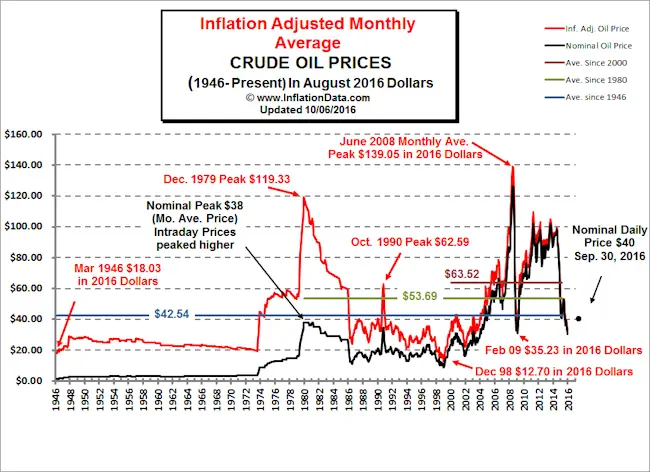
Because oil is the lifeblood of today's economy, if there’s less oil to go around, price shocks are inevitable. It's very likely we'll see prices climb back over $100 per barrel. Possibly well over.
Pick Your Poison 
This is why our view is that either 
  1. the world economy outgrows available oil somewhere in the 2018 – 2020 time frame, or 
  1. the world economy collapses first, thus pushing off an oil price shock by a few years (or longer, given the severity of the collapse) 
If (1) happens, the resulting oil price spike will kneecap a world economy already weighted down by the highest levels of debt ever recorded, currently totaling some 327% of GDP:
Related image
Remember, in 2008, oil spiked to $147 a barrel. The rest is history -- a massive credit crisis ensued.  While there was a mountain of dodgy debt centered around subprime loans in the US, what brought Greece to its knees wasn’t US housing debt, but its own unsustainable pile of debt coupled to a 100% dependence on imported oil --  which, figuratively and literally, broke the bank.
Image result for real oil price chart pictures
If (2) happens, then the price of oil declines, if not collapses. Demand withers away, the oil business cuts back on its exploration/extraction investments even further, so that much later, when the global economy is trying to recover, it then runs into an even more severe supply shortfall. It becomes extremely hard to get sustained GDP growth back online. 
More economic growth requires more energy. Always has and it always will. Oil is the most important form of energy of them all. But everyone assumes -- especially today when it appears as if we're "awash" in it given the current supply glut -- that we will always have access to as much as we need.
 7/1/17
Updated Monthly
Oil Prices: 
07/01/12....$99.25
07/01/17....$50.26   

Down 49%(rounded)
(oil prices approximately one year earlier due to weekends & holidays)
ANS West Coast prices   
OIL INDICATOR:  Positive  Oil indicator will remain positive until it's rise is greater than 75% from five years earlier.

Oil prices are well known for their volatility in the short term, longer term due to dwindling reserves energy prices are in a secular bull market.  Technologies such as fracking will extend the life of oil fields but major new discoveries arrive at a snails pace far slower than the world's growth.  

As long as prices rise in a slow and orderly pace our economy can adjust to those changes, however if prices spike (international tensions, war etc.) high energy costs behave as a massive deflationary tax. This will send our economy tumbling down and very possibly the U.S. stock market.

If oil prices rise greater than 75% from five years earlier, investors at that time should shift their portfolio geared towards deflationary times.  This would be an oil indicator as negative.

If oil prices rise from five years earlier less than 10% or drop then the inflationary play is in effect; a positive for economic growth along with possible higher stock prices.

Where to find five year earlier oil prices?  Alaska Department of Revenue    

Oil indicator positive                
20%  REIT's
20%  Energy
20%  P.M.'s
40%  Small Caps
  0%  Lt. Gov't Bonds

Oil indicator negative
  5%  REIT's
10%  Energy
10%  P.M's
10%  Small Caps
65%  Lt. Gov't Bonds

Vanguard Funds

REIT's
REIT Index Admiral  VGSLX

Energy
Energy Fund  VGENX

Precious Metals (P.M.'s)
Precious Metals and Mining Fund  VGPMX

Small Caps
Small Cap Value Index Admiral  VSIAX

Long Term Government Bonds
Long-Term Government Bond Index Admiral  VLGSX

Disclaimer

This blog site is not a registered financial advisor, broker or securities dealer and The Dividend Yield Investor is not responsible for what you do with your money.
This site strives for the highest standards of accuracy; however ERRORS AND OMISSIONS ARE ACCEPTED!
The Dividend Yield Investor is a blog site for entertainment and educational purposes ONLY.
The Dividend Yield Investor shall not be held liable for any loss and/or damages from the information herein.

Use this site at your own risk.

PAST PERFORMANCE IS NO GUARANTEE OF FUTURE RESULTS.

Monday, July 3, 2017

J. Paul Getty Quote! The professional investor has no choice but to sit by quietly while the mob has its day, until enthusiasm or panic of the speculators and non-professionals has been spent. He is not impatient, nor is he even in a very great hurry, for he is an investor, not a gambler or a speculator.


July 3, 2017


John P. Hussman, Ph.D.
In recent decades, we’ve seen the same kind of mesa formations in the equity market; points where historically extreme valuation bubbles temporarily draw S&P 500 10-year returns well above levels that would have been projected on the basis of valuations a decade earlier, with vertical plunges taking returns back to earth as valuations are restored.

Modest patterns like that are normal, but at the 2000 valuation extreme, and again today, they have been taken to levels that history will remember as monuments to speculative recklessness.
DYI:  I feel as if I’m the boy who cried wolf and yet the market continues to power ahead moving valuations higher and higher.  Yet we all know, or should know, as valuations climb future returns are inversely correlated.  Higher the valuation lower expected future returns.  The U.S. market as measured by the Shiller PE10 is at the nose bleed level of 29.66!
Image result for shiller pe chart pictures
Shiller PE ratio as of June 30, 2017....29.66

Stocks held or purchased today go to sleep like Rip Van Winkle waking in 12 years time your expected return with dividends reinvested is….drum roll please…positive 2.02%!  Assuming the market ends at its average of 16.76!  Houston we have a problem. PE10 valuation above the average since February 1991 except for a brief seven month moment from 2008 – 2009 time period, hence market valuation above its mean for over 25 years!  Unless you believe stocks have now reached a new permanent plateau moving the average up dramatically, stocks are poised to begin their journey of valuation below their long term average.  Using my Rip Van Winkle 12 year approach PE10 ending at 10 your return….drum roll please…negative average annual return of 2.19%! OUCH!

So…if you agree with my analyses what is an investor to do?  Look to other assets that are dramatically different or as stated in finance terms – uncorrelated assets – that rise and fall from different economic forces.  The late Harry Browne pioneered uncorrelated assets with his Permanent Portfolio concept of four assets – stocks, long term bonds, gold, and cash (short term notes).  His approach is a constant or fixed asset allocation of 25% into each category of assets rebalancing only when one of the assets moves 15% or more.  Simple concept and it works quite well for the fixed asset ultra defensive investor.  DYI has applied well known averages for stocks, long term bonds, and gold (gold mining companies) with cash being a holding area or bull pen.  From a fixed to active asset allocation model or in other words one or two of these three assets will be in a bull market with a bulk of your dollars participating.  How is this done?  Apply the same averaging formula to stocks, long term bonds, and gold.  Just simply look to the top of my blog and click on stock, bonds, gold for a complete explanation.  Cheers!
  DYI

Sunday, July 2, 2017

MSM’s
Fake News
Russian Narrative
Runs Out of Gas
MSM’s
Fake News
Replacement Narrative
Trump is Unfit for Office

Carl Bernstein calls for 'different kind of reporting' to take on 'malignant presidency'

To be sure, even Raskin acknowledges Congress and the country are in largely uncharted waters. The 25th Amendment was adopted in 1967 in response to the assassination of President John F. Kennedy and past presidential medical crises — including the heart attacks of Dwight Eisenhower and the illnesses of Franklin D. Roosevelt and Woodrow Wilson — to deal with instances where presidents become incapacitated and unable to perform the duties of their office. 
One of its provisions, known as Section 4, empowers the vice president along with a majority of the Cabinet to make a determination that a president is “unable to discharge the powers and duties” of the office, and then provide it in writing to Congress, resulting in the president’s removal. It’s a step that has never been taken.
 DYI
No
Bubbles
Yellen 

Fed's Yellen expects no new financial crisis in 'our lifetimes'


This is such a bizarre, naïve statement, that it's hard to know what to make of it. Yellen is expressing precisely the attitude that's always been prevalent prior to every financial crisis in world history. Politicians say "This time it's different," and "We've learned our lessons," and "It can't happen this time." And it doesn't happen this time, until it does. 
Actually, the lessons from the last financial crisis haven't been learned at all. The Fed and central banks around the world have been "printing" hundreds of trillions of dollars, and governments around the world have been borrowing that money and going into new debt at an exponentially increasing rate. We've recently been reporting that it's too late for Illinois and Puerto Rico, which have gone into so much debt there's literally no hope of every paying it off. 
This is true all around the world. According to a new report by the Institute of International Finance, global debt has reached $217 trillion in the first quarter of this year, and that's 327% of gross domestic product for the whole world. 
China in particular poses an enormous risk. China's total debt surpassed 304% of GDP as of May 2017, according to the IIF. 
Janet Yellen apparently believes that all this is no problem, that if a problem does arise, then the Fed or some other central bank can just print another trillion dollars in free money and use it to patch up the problem. So we have nothing to worry about.
Stock Market Bubble
There are many reasons why I believe that mainstream economists are airheads, and one of them is the belief that you can't detect a bubble until after it occurs. In the case of the DJIA, it's rather simple. If you analyze historical values of the DJIA, you find that in the 90-year period from 1904 to 1994 it grew at an average of 4.5% per year, including inflation. So since the DJIA started growing much more rapidly than 4.5% per year, starting in 1995, the you know that it's in a growing bubble. Today, the DJIA is at 258% of its long-term trend value, as determined by the 4.5% growth rate, so we can be sure that the DJIA is in an enormous bubble. In fact, it was at 255% of the trend value when the crash began in 1929, and fell to only 24% of the trend value by 1932, after several years of crashing. 
Another thing that mainstream economists are incapable of grasping is the concept of "Reversion of the Mean." This means that the average (or mean) of a value must be the same in the future as it was in the past. 
This is easiest to explain with the S&P 500 Price Earnings ratio (p/e ratio). The historic average value of the p/e ratio is 14, but since the 1990s, it's been well above the average, and today it's around 24. 
Now, airhead economists use the erroneous phrase "Reversion TO the Mean," and they say you should be prepared for the p/e ratio to revert to its mean value of 14. This would be a significant stock market correction, but it's only a small part of the story. 
If the p/e ratio only reverts to 14, then that means for the last 20 years, the average (or mean) value was well above 14. That doesn't satisfy the requirement that the average before 1995 was 14, and so after 1995 it also has to be 14. That's why we say "Reversion OF the Mean," which says that the average value must return to 14, which means that the p/e ratio would have to fall to around 5 for 20 years, just as it was well above 14 for the last 20 years. This portends major stock market crash. 
The members of the Federal Reserve are some of the major economists of our time, each with huge staffs to do research. And yet, Janet Yellen says that the Fed has everything under control, and there won't be a financial crisis "in our lifetimes." It's just absolutely bizarre.
DYI


Saturday, July 1, 2017

DYI's Allocation Formula is Now Down to a Scant 15%....Showing Signs of Secular Top for Stocks!


%
Allocation Formula
7-1-17
Updated Monthly

% Allocation = 100 – [100 x (Current PE10 – Avg. PE10 / 2)  /  (Avg.PE10 x 2 – Avg. PE10 / 2)]


% Stock Allocation 15% 

Logic behind this approach:
--As the stock market becomes more expensive, a conservative investor's stock allocation should go down. The rationale recognizes the reduced expected future returns for stocks, and the increasing risk. 
--The formula acknowledges the increased likelihood of the market falling from current levels based on historical valuation levels and regression to the median, rather than from volatility. Many agree this is the key to value investing.  
Please note there is controversy regarding the divisor (Avg. PE10).  The average since 1881 as reported by Multpl.com is 16.70.  However, Larry Swedroe and others believe that using a revised Shiller P/E mean of 19.6 , the number since 1960 ( a 53-year period), reflects more modern accounting procedures.


DYI adheres to the long view where over time the legacy (prior 1959) values will be absorbed into the average.  Also it can be said with just as much vigor the last 20 years corporate America has been noted for accounting irregularities.  So....If you use the higher or lower number, or average them, you'll be within the guide posts of value.      
  
DYI


This blog site is not a registered financial advisor, broker or securities dealer and The Dividend Yield Investor is not responsible for what you do with your money.
This site strives for the highest standards of accuracy; however ERRORS AND OMISSIONS ARE ACCEPTED!
The Dividend Yield Investor is a blog site for entertainment and educational purposes ONLY.
The Dividend Yield Investor shall not be held liable for any loss and/or damages from the information herein.
Use this site at your own risk.

PAST PERFORMANCE IS NO GUARANTEE OF FUTURE RESULTS.

The Formula.