Friday, January 25, 2019

Valuations
Are Crucial to
Investment Success
   The wealthy investor tends to be an expert on values. When bonds are cheap and bond yields are irresistibly high, he buys bonds. When stocks are on the bargain table and stock yields are attractive, he buys stocks. When real estate is a great value, he buys real estate. When great art or fine jewelry or gold is on the "give away" table, he buys art or diamonds or gold. In other words, the wealthy investor puts his money where the great values are.
  And if no outstanding values are available, the wealthy investor waits.  The wealthy investor knows what he is looking for, and he doesn't mind waiting months or even years for his next investment (they call that patience).
The late Dick Russel - Dow Theory Letters
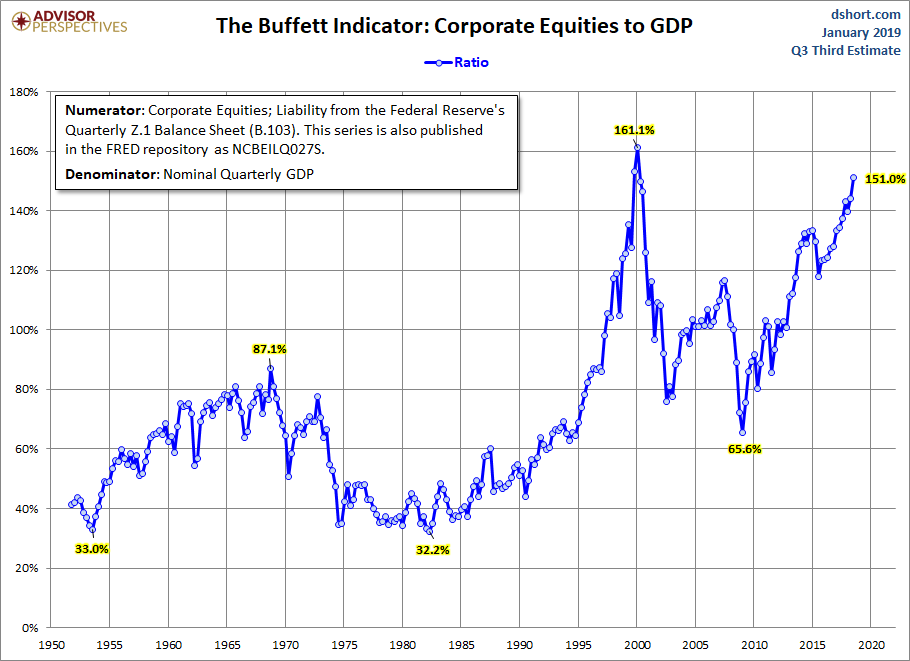
Buffett Indicator


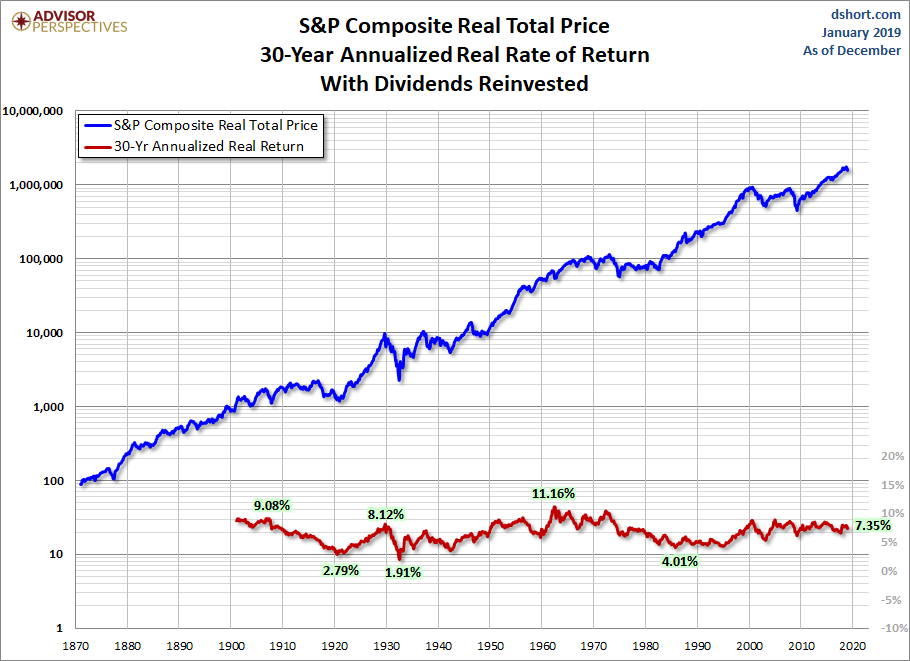
DYI:  The swings in returns going from a 10 year hold and even a 30 year hold – [stocks held or bought and then go to sleep like Rip Van Winkle awaken after x years] – will be huge all depending on valuations at entry.  The 30 has a return real return from a sub atomic low of 1.91% average annual return to a high of 11.16 and everything in between.  Place too much hard earned dollars at high valuations your returns will be anemic.  15 year holding periods has multiple losses.  When an individual has only 20 to 30 years to put it all together valuations become absolutely crucial.

Ben Graham’s Corner – DYI updates once per month – is made for those who are dollar cost averaging such as the typical 401k owner.  Currently stocks valuations are so insanely high an investor will be buying bonds.  Once valuations improve you can begin systematically purchasing stocks and once valuations drop significantly sell off the bonds and purchase stocks on a lump sum basis.  Old Ben’s formula is perfect for dollar cost averaging.        

Ben Graham's Corner

Margin of Safety!


Central Concept of Investment for the purchase of Common Stocks.
"The danger to investors lies in concentrating their purchases in the upper levels of the market..."

Stocks compared to bonds:
Earnings Yield Coverage Ratio - [EYC Ratio]

EYC Ratio = 1/PE10 x 100 x 1.1 / Bond Rate
1.75 plus: Safe for large lump sums & DCA
1.30 plus: Safe for DCA

1.29 or less: Mid-Point - Hold stocks and purchase bonds.

1.00 or less: Sell stocks - Purchase Bonds

Current EYC Ratio: 0.95 (rounded)
As of  01-01-19
Updated Monthly

PE10 as report by Multpl.com
DCA is Dollar Cost Averaging.
Lump Sum any amount greater than yearly salary.

PE10  ..........27.51
Bond Rate...4.21%

Over a ten-year period the typical excess of stock earnings power over bond interest may aggregate 4/3 of the price paid. This figure is sufficient to provide a very real margin of safety--which, under favorable conditions, will prevent or minimize a loss......If the purchases are made at the average level of the market over a span of years, the prices paid should carry with them assurance of an adequate margin of safety.  The danger to investors lies in concentrating their purchases in the upper levels of the market.....

Common Sense Investing:
The Papers of Benjamin Graham
Benjamin Graham
DYI

Thursday, January 24, 2019

U.S.
Housing
Mini bubble!
House Price Index

HPI versus OER

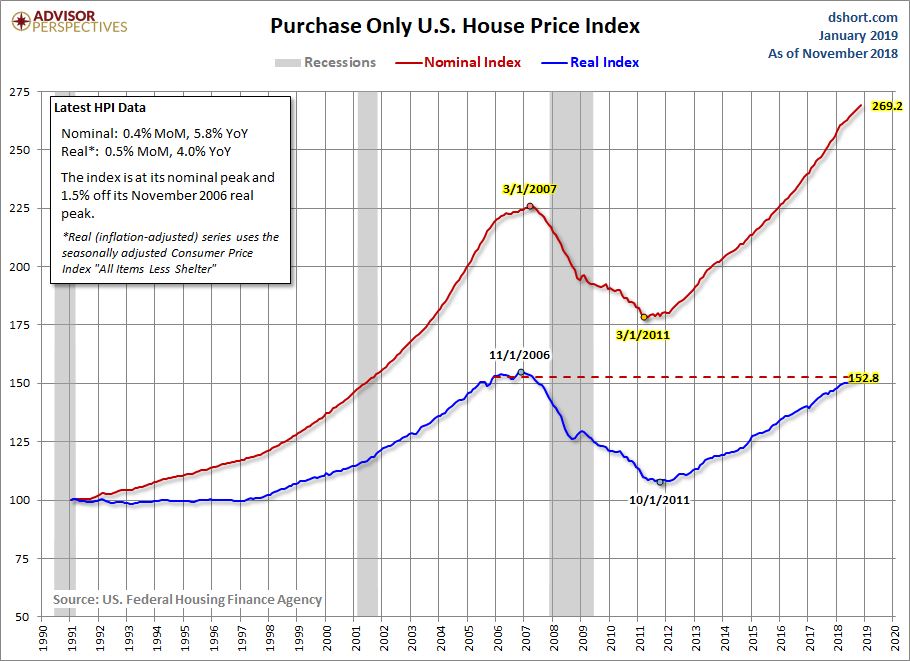
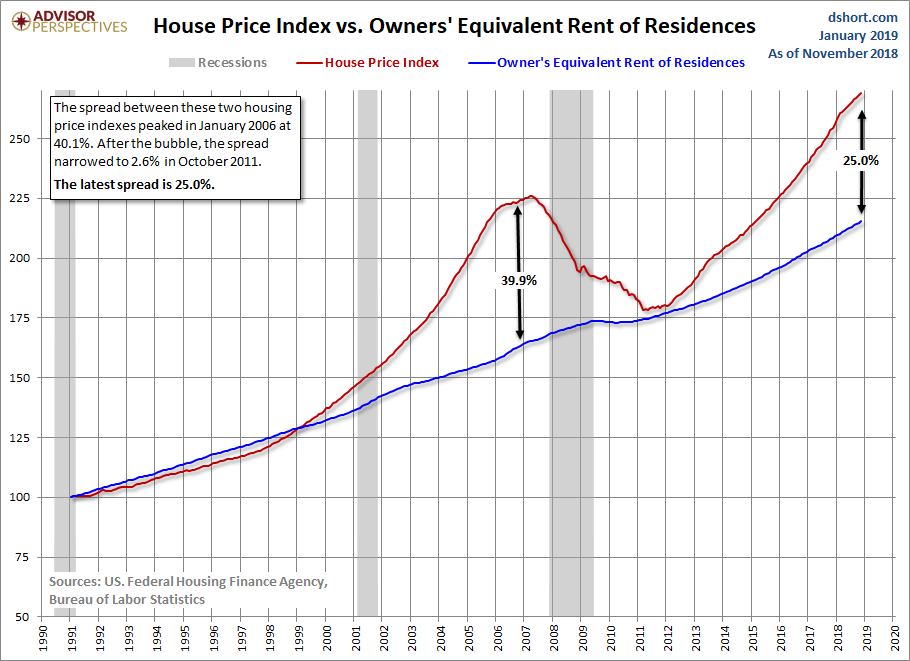
DYI:  U.S. real estate mini bubble has arrived.  This time rampant speculation is only at the hot spots and not U.S. wide as before.  Nevertheless this is a bubble just not of biblical proportions hence it is a mini.  Real estate [R.E.] will dip in price [10% - 25%] even if America experiences a mild recession due to homes being overvalued as compared to rents.  A major decline in home prices – greater than 25% - will occur only due to the general health of the overall economy.
DYI
The
Pin
Has Found The Bubble! 

Canada’s Majestic Housing Bubble Deflates, 

Media Hype U-Turns

National home sales across Canada slipped for the second consecutive year, dropping 11% when compared to 2017. It was indeed the steepest annual decline since the Financial Crisis in 2008. As a result, the average home price leaked lower to $488,699, a 4% decline from last year. The decline marked the first year-over-year drop since 2008, when the national average slipped a mere 0.71%. 
But as Shiller writes, all mania’s eventually come to an end, and the media plays an equal role in compounding the role of public sentiment in the opposite direction.

As Investors Flee Australia’s Housing Bust, Sales of New Houses Plunge to Record Low


And this time it’s not rising interest rates that have caused the downturn: Mortgage rates in Australia are near record lows, and the policy rate of the Reserve Bank of Australia is stuck at a record low 1.5%. 
Instead, the downturn was triggered by sky-high prices in one of the world’s most fabulous housing bubbles that smacked into a regulatory crackdown on some of the elements that had made those sky-high prices even possible: Mortgage fraud, bank wrongdoing, reckless lending, and excessive property speculation aided and abetted by the banks.

No More TV and iPad Giveaways for New Zealand Home Buyers

Would-be home owners are instead being scrutinized more than ever before to ensure they can service a loan, mortgage brokers say. The change in attitude is tightening the screws on the property market and raising fears that New Zealand could join Australia in seeing house prices start to slide.
DYI:  The long awaited worldwide recession in my judgment has begun.  How long will the United States hold out before the ripple effect sets in is anyone’s guess.  It appears the slide will be felt this year, if not; then very early 2020.  I’ll keep my eyes wide open for any concrete signs for an American downturn.
 DYI

Wednesday, January 23, 2019

The
Hoax
of
Sandy Hook

We are to believe that an emaciated, totally underweight 6'2 112lb adult was able to even walk not to mention drive!? You know that if that was real, he would be very ill and hospitalized with a feeding tube inserted into him.
Image result for adam lanza pictures
His so called psychiatrist Dr. Fox who only saw him 2x alongside an assigned psychologist who saw him all of 4x diagnosed him with Asperger's and PDD.

Asperger's being a very high functioning, articulate, intelligent person on the Autism Spectrum who will likely suffer from being clumsy (many tend to walk with the step taken from the ball of their foot as if to have a hop like appearance to their walk) making them trip easier than a typical person would but nonetheless are for the most part very successful in life due to their high intelligence.

Take into consideration that it is stated that Adam was 6'2" 112lbs and wore a size 8 shoe! This disproportionate body would surely make him even more uncoordinated.

Asperger's has also be labeled "social awkwardness" for decades because of they tend to be more shy, timid, and obviously not great at speaking or feeling comfortable in social settings yet PDD which is Pervasive Developmental Disorder being on the opposite end of the Autism spectrum causes one to have sever anxiety, fear of being out in public (angora phobia) severe reactions to BRIGHT LIGHTS and LOUD NOISES, reclusive and not very verbal or intelligent.

I like the shills to explain intelligently how it was possible for Adam to drive to the school, pack 50 lbs. of gear and shoot all those 26 bodies Rambo style in 10 minutes.
*****************************************
We are to believe that 'glamour girl', Kaitlyn-Roig DeBullshit fits herself, and 15 first graders into a 3' x 4' x 6' toilet, which even she admitted was so small, that she felt uncomfortable using it as it was too small for her alone??
Image result for Kaitlin-Roig closet pictures
Kaitlyn-Roig
Actress 
 “Who Wants To Be A Millionaire"
At least now she is admitting that the door opened inward. So now she has to say that she couldn't close the door without "rearranging" the children. Were they lying on floor stacked like a wood pile? All standing up? Even giving her the leeway of three on top of the tank [oh, and one on the TP dispenser so she had to hold that one on], It is impossible to fit that many people in that space.

BTW, first graders are bigger than you think, especially since so many now are overweight. How did they last 45 minutes? Pretty tough to get enough oxygen when hyperventilating in a small sardine can.

Common sense would tell you they would have been crying, trying to breathe and not suffocate, rolling over up down however she says she placed them to stretch out. You've heard of stampedes? People don't all die from trauma but because they were pushed down so hard they smothered. Oh!! Don't forget having to open the door (squash everyone behind it?) and grab that ineffective book case to barricade a door that opens inward. And she sure did this in record time.
 DYI
Bubble
News

Straw in Wind? Near-Junk Ratings Dominate US Corporate Bonds

The scary thing is that, in the estimation of Grant’s Interest Rate Observer, business debt as a percent of GDP tops 72%, which is more than the peak of the last economic up-cycle, 68.8% in 2017’s first quarter. 
As financial pundit William D. Cohan recently wrote, vis-a-vis the corporate debt situation: “It’s been quite a party. Now comes the hangover.”

DYI:  What more can one say?  One lite economic breeze will send this house of cards falling cascading into a major downturn dropping high yield, junk bonds and stocks down to a significant degree.  When is the question?  No one knows for sure but we can say the U.S. economy is on borrowed time.  It appears that Europe borrowed time has run out and is now in recession.  With that in mind the economy will go negative soon most likely this year.
DYI

Tuesday, January 22, 2019

The
Big
Bang

Richard Wolff: The Next Economic Crisis Is Coming

RICHARD WOLFF:
And here’s another one that people don’t talk about. The big tax cut last December, 2017, gave an awful lot of money to the richest Americans and to big corporations. They had no incentive to plow that into their businesses, because Americans can’t buy any more than they already do. They’re up to their necks in debt and all the rest.

So there’s no need for employers to raise wages to attract workers, they can just pull them slowly out of the desperate population of people who haven’t worked for years and have run out of savings. 

They can’t turn to their friends and relatives anymore, so they come back and accept the jobs that they were once too proud to accept. It’s a real downturn of the quality of life of America, which is why you don’t see the wages going up and why you see the anger and the bitterness, because all of the promises of Obama before, and of Trump now, are not changing that basic situation.


Well at this point I think it really depends on what indexes you’re looking at. The biggest thing that’s kept this economy going in the last few years should make everybody tremble. It’s called debt, let me give you just a couple of examples. Ten years ago, at the height of the crash, the total debt carried by students in the United States was in the neighborhood of $700 billion, an enormous sum.
What is it today? Over twice that, one-and-a-half trillion dollars. The reason part of our economy hasn’t collapsed is that students have taken up an enormous amount of debt that they cannot afford, in order to get degrees which will let them get jobs whose incomes will not allow them to pay back the debts. And forget about getting married, forget about having a family.
Image result for mish gold vs faith in central banks chart pictures

Bank of England Admits that Loans Come FIRST … and Deposits FOLLOW

Commercial banks create money, in the form of bank deposits, by making new loans. When a bank makes a loan, for example to someone taking out a mortgage to buy a house, it does not typically do so by giving them thousands of pounds worth of banknotes. Instead, it credits their bank account with a bank deposit of the size of the mortgage. At that moment, new money is created. For this reason, some economists have referred to bank deposits as ‘fountain pen money’, created at the stroke of bankers’ pens when they approve loans.
Video Federal Reserve

How To Be a Crook


Not a single respondent to the International Association of Credit Portfolio Managers survey anticipates default rates will drop. It's the worst quarterly outlook since mid-2009, during the depths of the Great Recession. 
None of this means defaults will spike to the levels experienced in the aftermath of the 2008 financial crisis. Rather, investors are acknowledging that the historically low level of defaults will inevitably climb as economic growth slows.

Rising Credit-Card Use Shows Consumers Are Strapped

Even though evidence is mounting that the U.S. economy may be soon heading into a recession, there are plenty of analysts who say that the surge in credit card borrowing is a sign of strong confidence among households. That's hardly the case. In fact, households' confidence in the future growth of their incomes has been cooling since late last summer, which means borrowers will only reach for what’s in their wallet to compensate for what their paychecks will not cover. 
Add it all up and it’s likely that any rush to "charge it" will be a last gasp as income expectations continue to decline and eventually cross lines with credit card borrowing. The closer we get to recession, the more desperate a sign credit card borrowing is anything but a reflection on strengthening in household finances. Households wouldn’t be reporting that they expect their incomes to rise less if that was the case.
DYI

Thursday, January 17, 2019

Active
Asset Allocation

DOW/GOLD – A 98% FALL COMING

The big Megaphone pattern in the Dow/Gold ratio since 1913 completed on the upside in 1999. Between 1999 and 2011, the ratio crashed by 87%. This is not the end of the down trend. The next big move will at least reach the bottom of the Megaphone. I would be surprised if the ratio doesn’t go well below the 1 level it reached in 1980. More likely is 1 Dow to 1/2 ounce of gold or lower.
Image result for dow gold ratio chart pictures
As of 1/15/19 Dow/Gold Ratio is 18.48
A fall of that magnitude will involve a stock crash from here of 98% against gold. For the few who will anticipate this fall, it will lead to fortune. But for the 99.5% of investors who will not solve this relatively simple Gordian knot, it will mean misery and the biggest wealth destruction in history.


What is important to understand is that governments and central banks have created a bubble of such proportions that when it pops, it will lead to a wealth destruction and a wealth transfer never before seen in history.
I am here taking the Dow as an example of a stock market but remember that the next crash will be a global phenomenon and no market will escape.
100 years of financial mismanagement has not finished the 5,000 year track record of gold as the only money which has survived in history. The next 4 to 8 years will prove that again.

Harry Browne and the Permanent Portfolio Asset Allocation

There are many ways to construct an investment portfolio. My preference is to have your core asset classes be U.S. stocks, international stocks, and U.S. bonds, but there are other ways to construct an asset allocation. One lazy portfolio that is favored by more conservative or pessimistic investors is the so-called “permanent portfolio.” Its defining characteristic is a high percentage of gold and a relatively low percentage of stocks. Let’s take a look at this portfolio and see if it might be the asset allocation for you. Harry Browne wrote “Fail-Save Investing: Lifelong Security in 30 Minutes” in 2001, where he describes the permanent portfolio. He markets the permanent portfolio as one designed to perform well in a wide range of market conditions. The permanent portfolio proposed by Harry Browne consisted of equal weighting in four asset classes: 25% U.S. Stocks25% Treasury Bills25% Long-Term Treasury Bonds25% Gold

Using historical returns from Portfolio Visualizer, let’s see how the permanent portfolio has done compared to a standard three-fund portfolio of 60% U.S. stocks, 30% international stocks, and 10% total bond market since the publication of Harry Browne’s Fail-Save Investing in 2001 (assuming annual rebalancing):
2001 – 2017
Permanent Portfolio 214.9%
Three Fund Portfolio 166.6%
The permanent portfolio actually outperformed the three-fund portfolio from 2001-2017. Of course, using 2001 as a starting date would be the worst possible time for the three-fund portfolio, as that was during the tech crash and the market experienced two crashes during this time period. Let’s look at the performance of the permanent portfolio versus the three-fund portfolio starting in 1987, when historical data for all asset classes are available on Portfolio Visualizer:
Image result for permanent vs 3 fund portfolio 1987-2017 chart pictures
Active Asset Allocation

DYI:  Fixed vs. active asset allocation argument has been going on ever since the modern [or throwback] portfolio theory [MPT] came into being.  Harry Browne at that time was a pioneer in fixed asset allocation or MPT of its time.  However whether it’s the Permanent Portfolio allocation [PPA] or the 3 asset allocation as describe in the article or any other fixed allocations they all suffer from either under or over allocated during times of high valuation or low valuations.

Simply put whether Harry’s PPA or some other fixed allocation what would set my hair on fire is when one or more of the allocations were severely over or undervalued.  Today stocks and a case can be made for long term bonds of massive overvaluation.  Why would I want 25% in stocks with PPA or God forbid 60% with the 3 asset plan?  Stocks over the long haul returns will be sub atomically low and very possibly at a loss over the next 7 to 10 years.  Only until valuations improve; providing investors with improved compounding thus creating gains commensurate with the level of risk.  The same can be said of long term bonds.         

Valuation Driven Allocation Formula

DYI’s allocation only changes based upon our formula for determining our model portfolio allocation of our four assets.  The formulas are not proprietary just click at the top of the blog for stocks, bonds, or gold they are all there for you. 

If all three – cash is our default allocation – are at average or fair value at the same time [a highly unlikely event] then each of the assets would have 25% in stocks, bonds, cash, gold just like Harry.  With valuations so insane for stocks and bonds our formula has kicked us out of the stock market [and rightfully so] and almost for long term bonds.
Updated Monthly

AGGRESSIVE PORTFOLIO - ACTIVE ALLOCATION - 01/1/19

Active Allocation Bands (excluding cash) 0% to 50%
68% - Cash -Short Term Bond Index - VBIRX
29% -Gold- Global Capital Cycles Fund - VGPMX
 3% -Lt. Bonds- Long Term Bond Index - VBLTX
 0% -Stocks- Total Stock Market Index - VTSAX
[See Disclaimer]
DYI’s goal is to outperform Harry’s Permanent Portfolio and to achieve at least ¾ of the long term return of any of the other fixed allocations including 100% stock allocation with significantly less market gyration [except upside volatility which we all love so much].

Why is Active Asset Allocation So Important?

The reason active allocation is so important most folks only have a 20 year to 30 year window to put it all together for long term planning such as retirement.  This is important for even shorter periods of time – 7 to 10 years – saving for a house attempting to have a massive down payment to relieve the owners of a large mortgage payment.

Those who do not understand valuations that drive future returns would only have good or bad luck with their investments.  If this was the late 1970’s future returns would be outstanding for stock and long term bond investors.  Conversely today it would just be the polar opposite.  The same could be said for gold terrible time to buy in 1980 and a fantastic time to buy in the late 1990’s all known by monitoring the Dow/Gold Ratio.

Until Next Time
DYI

Tuesday, January 15, 2019

Head of the Snake
The Federal Reserve 
"If the American people ever allow private banks to control the issue of their currency, first by [asset] inflation, then by [asset] deflation, the banks and corporations that will grow up around them will deprive the people of all property until their children wake up homeless on the continent their Fathers conquered.

I believe that banking institutions are more dangerous to our liberties than standing armies.  The issuing power should be taken from the banks and restored to the people, to whom it properly belongs."
Thomas Jefferson
Image result for federal reserve pictures

The Crash Of The “Everything Bubble” Started In 2018 - Here’s What Comes Next In 2019

In almost every instance during which the Fed created a crash environment, banking institutions were able to use the opportunity to snatch up hard assets for pennies on the dollar, as well as steal more political and social power. 
During the Great Depression, major banks absorbed thousands of smaller local banks as well as all the assets those banks held. In 2008, banks and corporations enjoyed a deluge of easy money paid for by American taxpayers for generations to come, while also vacuuming up hard assets like distressed home mortgages. 
An even greater prize for banking elites is global centralization of economic authority, which is what I believe their goal is as the next engineered crash runs its course. 
As crisis leads to catastrophe, it will be institutions driven by globalism like the International Monetary Fund (IMF) and Bank for International Settlements (BIS) that step in to “save the day”.
This is a controlled demolition of the economy and markets. The Fed will jawbone as much as possible to keep the system from imploding too fast, because jawboning is the only tool that is left. In the meantime, 
Powell will keep cutting assets and raising interest rates on schedule. 
This will inevitably translate into lower prices in equities as the system is “steam valved” down. Blind faith by investors will only go so far. They will be left holding the bag, right along with pensions.
 Secular Trends with a Regression
DYI:  Once again the Federal Reserve along with all other 1st world central banks have blown another bubble that will pop at the time of their choosing sending asset prices spiraling down from 60% to 75% for stocks and at the very least 50% for high yielding corporate bonds [BBB quality]. Large numbers of junk bonds will simply go to zero with the remaining on life support down 80% to 90%!  The question is how long this total inversion from peak secular high to trough secular low will take.  My guess – admittedly is not much help – 3 to 8 years [see chart below].  Will it be similar to the 1929 to 1932 or the long dragged out market decline from 1968 to 1982 with multiple cyclical market ups and downs before bottoming out?  Who knows?
 
What DYI does know our valuation based averaging formula will only add to our asset allocation model as valuation(s) improve substantially increasing future return systematically.  Until that happens DYI’s model portfolio remains with plenty of dry powder for the hunt when valuations improve.
     Updated Monthly

AGGRESSIVE PORTFOLIO - ACTIVE ALLOCATION - 01/1/19

Active Allocation Bands (excluding cash) 0% to 50%
68% - Cash -Short Term Bond Index - VBIRX
29% -Gold- Global Capital Cycles Fund - VGPMX
 3% -Lt. Bonds- Long Term Bond Index - VBLTX
 0% -Stocks- Total Stock Market Index - VTSAX  

Secular Trends
DYI

Monday, January 14, 2019

Recession
Coming to a Country near You?

Matthew Lynn: 

Next eurozone crisis has begun and will lead to more money creation

Industrial output is in crashing. Retail sales have stagnated. Business confidence has dropped, and investment is heading south. A sharp slowdown might have been expected for Britain heading out of the European Union, America where the President is busily ripping up half a century worth of carefully constructed trade agreements, or China, which has been on a decade of wild, credit-fuelled growth. 
But the real slowdown is happening in the one place where few economists expected it. It is now painfully obvious that the eurozone is heading into a sharp recession.
The fleeting recovery of the 2017 and early 2018 now looks to have been fuelled purely by the two trillion of freshly minted euros the ECB threw at the economy. It has proved incapable of creating a self-sustaining recovery. Th ECB was expected to start normalising policy this year, ending QE and raising interest rates. In the face of the latest data, a rise in rates can now be ruled out. The central bank is far more likely to have to start printing money again by the spring -- but by then it may already be too late to pull the zone out of a slump.
 DYI
Budget
Busters
Empire in Decline? 

Medicare’s Trust Fund Is Set to Run Out in 8 Years. Social Security, 16.

The Medicare trust fund will be depleted in 2026, the administration said. By contrast, the government said last year that the trust fund would be exhausted in 2029. 
In a companion report, federal officials said the Social Security Trust Funds for old-age benefits and disability insurance, taken together, could be depleted in 2034, the same year projected in last year’s report. The fund that helps tens of millions of retirees is expected to be depleted a year earlier than projected last year, while the outlook for the disability trust fund is more favorable. 
 “The current trajectories in health spending are both unsustainable and unmatched by increases in quality,” Alex M. Azar II, the secretary of health and human services and a trustee of Medicare and Social Security, said on Tuesday. 
A major reason for Social Security’s long-term financial problems is a decline in the number of workers for each beneficiary. 
In 1960, there were about five workers for every Social Security beneficiary. The ratio of workers to beneficiaries fell to 3.3 in 2005 and then to 2.8 in 2016. It will decline further to about 2.2 by 2035, when most baby boomers will have retired, officials said. 
The aging of the population is another factor in the growth of the two entitlement programs. The number of Medicare beneficiaries is expected to surge to 87 million in 2040, from 60 million this year, according to Medicare actuaries. And the number of people on Social Security is expected to climb to 90 million, from 62 million, in the same period.
DYI:  The trust funds that are nothing more than IOU’s between government agencies in this case Social Security/Medicare/Medicaid and the Treasury Department.  Medicare will run out in 8 years requiring a 76% decline in benefits to maintain this as a stand alone program if Congress does not intervene.  The same can be said of Social Security slated to run out of trust funds in the year 2034 requiring a 21% decline in benefits to put this program back into balance if Congress does not intervene.
 
These projections do not take into the very real possibility of recessions/depressions that would clip a few years off of these projections.  With a recession possibility coming in 2019 trust fund depletion could easily be clip by two or three years making the day of reckoning especially for Medicare/Medicaid within five years the new political hot potatoes. 

So far no sitting President will enforce 100 year old laws – Robinson/Patman, Clayton, and Sherman Anti Trust acts – to reign in the medical industrial complex that colludes to price fix and now moving from local to regional monopolies.  This industry pumps out more campaign money than the military industrial complex that is clearly the impediment to any reform.  Add on Social Security trust funds realistically running out in 2028 [DYI’s estimate] these two massive programs colliding with the military industrial complex.

Simply put if zero reform arrives official budget deficits will soar by 750 to 1,000 billion per year!  This will be bye bye to world domination by the U.S. military as U.S. Federal debt will come into question – dropping quickly to single A [possibly BBB] status by Standard & Poors – jacking up interest rates as investors demand compensation for the new perceived risk thus ballooning deficits ever higher for another round of ever higher rates compensating the never ending increased risk of default by inflation.


In the short term DYI’s forecast is first a deflationary smash as these programs funding problems come into focus along with massive corporate debt that will be defaulting during the next economic downturn.  Interest rates will drop significantly with the likely hood with Treasury notes of 5 years or less going negative.  Unless reform is forthcoming markets for our government debt will come into question thus moving rates up all during an economic downturn that could easily move from recession to depression as politicians crank up the money creation – thus inflating off – government liabilities.

DYI