Sunday, June 25, 2017

Washington Post’s
Newest Fantasy 
Early last August, an envelope with extraordinary handling restrictions arrived at the White House. Sent by courier from the CIA, it carried “eyes only” instructions that its contents be shown to just four people: President Barack Obama and three senior aides. 
Inside was an intelligence bombshell, a report drawn from sourcing deep inside the Russian government that detailed Russian President Vladi­mir Putin’s direct involvement in a cyber campaign to disrupt and discredit the U.S. presidential race. 
But it went further. The intelligence captured Putin’s specific instructions on the operation’s audacious objectives — defeat or at least damage the Democratic nominee, Hillary Clinton, and help elect her opponent, Donald Trump.
 Washington Post
And
The Deep State
But it was less than three years ago that Amazon began to achieve any profits to speak of. And, even today, you’d be shocked to know how high its revenues are and how relatively low its profits are. 
For instance, in 2015, Amazon’s fourth quarter revenues were an astronomical $35.7 billion. But its net income was, by comparison, a measly $482 million. Last year, Amazon’s fourth quarter revenue was up 22 percent to $43.7 billion. It’s net income was $749 million. 
I tell you all this so you don’t think what I’m about to tell you represents chump change for Amazon and Bezos. 
The first profitable year for Amazon was 2013. Fourth quarter profits were $239 million and $274 million for the year. The year before, Amazon posted a loss for 2012 of $39 million. 
What happened to make 2013 so much better than the year before? 
Amazon won a $600 million cloud computer contract from the CIA. That was the difference – more than the difference. 
Later that year, Jeff Bezos bought the Washington Post for $250 million. 
To put that another way, Bezos used less than half the money he got from the CIA to buy the Washington Post. 
Do you think that was a sweetheart deal? 
I do. And like others, I believe it’s something Americans should know about. For instance, the Washington Post often quotes unnamed CIA sources in its reporting. Yet, the Post doesn’t disclose that the CIA paid the owner of the paper more than twice what it cost to buy it. You won’t find any mention of this deal on the Washington Post’s Wikipedia page, either. Not worth mentioning, apparently. 
The Washington Post has been on the Russian-Trump story like white on rice ever since – along with the New York Times, CNN, ABC News, CBS News, NBC News and the rest of the pack of jackals. This investigation has been going on since 2016, yet no evidence has been found to support the “collusion.” 
Wouldn’t you like to see an investigation into the collusion between John Brennan, Jeff Bezos, Amazon, the Washington Post and the CIA? 
I sure would.
DYI:  Anything that comes out of the Washington Post should be held to the highest level of skepticism all to the benefit of the deep state and the entrenched political class whether Democrat’s or Republican’s.  Their goal is a one world government run by a corporate feudal state and anyone of importance who stands in their way (deep state – corporate elites) will be either be ignored, dismissed, ridiculed, or smeared by the main stream legacy press.
 DYI 
Stop Stealing
The
Government Hates the Competition

Senate Bill to Force Citizens to Register Cash Not in a Bank, Violators Get 10 Years in Prison

Under the guise of combating money laundering, Senate Bill 1241, “Combating Money Laundering, Terrorist Financing, and Counterfeiting Act of 2017,” ramps up regulation of digital currency and other autocratic financial controls in an attempt to ensure none of your assets can escape one of the State’s most nefarious, despised powers: civil asset forfeiture. 
All of this under the farcically broad umbrella of fighting terrorism. 
For some time, a war on cash has been brewing behind the closed doors of government, and — although officials prefer to claim counterfeiting, terrorism, and money laundering as the impetus for asset tracking — in actuality, physical currency facilitates black market and untaxed transactions, and, most imperatively to the U.S., cannot be thefted under civil asset forfeiture laws as easily as money exchanged digitally. 
Noncompliance with the tyrannical law — including failing to fill out the aforementioned form — would incur penalties befitting a fascist dictatorship: an individual could find the entirety of their assets seized, not just those unreported, and could be locked in a prison cage for up to ten years.
Video

DYI:  From day one the war on terror and ongoing culture war has been used as camouflage to strip Americans systemically of our rights and deprive the citizens of income and assets.   The above video describes the ins and outs of this tyrannical bill despite its name will do nothing to fight terrorism only to further subjugate American citizens.  Don’t be surprised if some sort crises hits; bank failure, war with North Korea, or terrorist attack (real or faked) on American soil Congress slips this bill through hopefully President Trump will use his veto power.

DYI

Wednesday, June 21, 2017

Bubble
News

Is Amazon/Whole Foods This Cycle’s AOL/Time Warner – A Sign That The Party’s Over?

Towards the end of the 1990s tech stock bubble, “new media” – i.e., the Internet — was ascendant and old media like magazines, newspapers and broadcast TV were yesterday’s news. This was reflected in relative stock valuations, which gave Internet pioneer AOL the ability to buy venerable media giant Time Warner for what looked (accurately in retrospect) like an insane amount of money. 
When the next bear market hits, though, that kind 
of money might seem a bit hubristic. 
As with so many other extraordinary recent market events (record-high stock prices combined with record-low volatility, 
negative yields on government bonds, soaring debt/GDP combined with falling inflation), 
Amazon/Whole Foods might or might not be the 
bell that rings at the top. 
But when the history of this time is written, 
there’s a good chance that it will be somewhere on the list.
 DYI
Monopoly Rights?
Decreases Prices??

KHN Exclusive: White House task force echoes Pharma proposals

President Donald Trump repeatedly talks tough about reining in the pharmaceutical industry, but his administration’s efforts to lower drug prices are shrouded in secrecy. 
To solve the crisis of high drug prices, the group discussed strengthening the monopoly rights of pharmaceuticals overseas, 
ending discounts for low-income hospitals and accelerating drug approvals by the Food and Drug Administration. 
The White House declined to comment on the working group. 
These recommendations would not lower drug prices, experts say. Such measures “would be like a firefighter spraying gasoline on your burning garage,” Prasad said.
 DYI:  Out right advocate for monopoly power whether here or oversees is affront to our free enterprise system and will no doubt end up furthering the pharmaceuticals oligarchs position enabling these corporations to increase prices at will.  The person named Prasad is absolutely correct if these proposal are enacted it will be throwing gasoline onto a raging fire.

Obama Care is only a small part of the problem for health care.  The real problem lies with the underlining medical companies who collude in order to price fix and form monopolies relentlessly pushing up prices at a 9% to 10% per year.  The Medical Industrial Complex is now costing Americans 20% of the entire U.S. economy.  When combined with the Military Industrial Complex and the Student Loan Debacle you don’t have to have a doctorate in economics to figure out why growth has been so slow.
DYI

Tuesday, June 20, 2017

Debtor Nation
America

  1. About 1 in 4 literally have no emergency savings. A survey released Tuesday by Bankrate.com found that 24% don’t have even a single dollar saved for an emergency. And that’s just one of many surveys showing how little we have saved: A survey released in January by Bankrate found that nearly 60% of Americans wouldn’t have enough savings to pay for a $500 expense if it came up unexpectedly. What’s more, more than one in five say they’d slap down their credit card to pay that expense and more than one in would mooch off family to get the cash. Experts recommend that Americans have a least three to six months of income in the bank to pay for unexpected emergencies.
  2. We are more worried about paying for our next vacation than about saving enough for retirement. That’s the finding of a study released this week by COUNTRY Financial, in which Americans report being more concerned about affording that vaca vacations (36%) than having adequate retirement savings (32%). That may explain, in part, why more than half of Americans will be broke when we retire, according to a survey from GoBankingRates.com.
  3. Millions of us hide money from our spouses and partners. An estimated 12 million Americans confess they have kept a source of money secret from their romantic partners, according to CreditCards.com. That’s typically not smart, experts say: “Any time you get into these kinds of things where you are operating behind the scenes, it usually comes out at some point,” Corey Allan, a marriage and family therapist told Credit Cards.com. “We can’t keep things hidden, especially in today’s technological world. Any spouse who has any kind of suspicion can become a detective and find it.” (Also see: If you have sex with a rich millennial, expect this power dynamic.)
  4. We prioritize paying the wrong bills first. When we can’t pay all our bills, we make bad choices about which to pay. “Consumers in financial distress tend to prioritize unsecured personal loans ahead of other credit products such as auto loans, mortgages and credit cards,” according to a study of roughly two million consumers who had all four types of debt out this week from credit monitoring service TransUnion. But experts say that’s a backwards way to handle these bills.
  5. We’ve racked up $1 trillion in credit card debt — and that’s just a fraction of what we owe. That’s according to data released this year from the Federal Reserve, which found that U.S. consumers owe $1.0004 trillion on their cards, up 6.2% from a year ago; this is the highest amount owed since January 2009. What’s more, this isn’t the only consumer debt to top $1 trillion. We now also owe more than $1 trillion for our cars, and for our student loans, the data showed.
DYI:  I was taught from day one by my father “never play the banker’s game” of debt servitude.  If you look into the middle section of billionaires – or what I call sarcastically the middle class billionaire – two thirds of them are bankers…need I say more?  Their way of making money is customers paying interest income and encouraging the masses into perpetual debt.  If you are in debt; get out of debt and if you are out of debt; stay out of debt.  You will have to forgo some of the finer things in life at least over the short term until you are debt free and have built a nest egg to financially fight off all of life’s calamities.  It can be done IF you are truly committed.  Dave Ramsey’s baby steps are an excellent starting point and I’ll throw in a few of my ideas as well.


Baby Step 1 – $1,000 to start an Emergency Fund
Baby Step 2 – Pay off all debt using the Debt Snowball
Baby Step 3 – 3 to 6 months of expenses in savings
Baby Step 4 – 15% of  income into Roth IRAs and pre-tax retirement
Baby Step 5 – College funding for children
Baby Step 6 – Pay off home early
Baby Step 7 – Build wealth and give!

DYI:  Baby Step 1 – Emergency Fund
An emergency fund is for those unexpected events in life you can't plan for. Whether there's a plumbing issue and everything but the kitchen sink is draining, or your brakes are squealing at every stop sign, you can be ready! 
In this first step, the goal is to save $1,000 as fast as you can. Go through your storage boxes and sell some stuff. Work an extra job. Do whatever it takes to start saving money. Once you have it, open a checking account that is separate from your regular account and put the cash there. When a car battery goes out or a baseball meets a window in your house, you won't have to go into debt to fix it. You don't want to dig a deeper hole while you're trying to work your way out.
Completely agree with Dave.  This is the beginning phase of changing your thinking from debt to paying cash…it is crucial…the cycle of additional debt accumulation must end.    

Baby Step 2 - Pay off all debts except the mortgage
List all debts but the house in order. The smallest balance should be your number one priority. Don't worry about interest rates unless two debts have similar payoffs. If that's the case, then list the higher interest rate debt first. 
This step will make a huge difference in your everyday life. You'll use the debt snowball to knock out your debts one by one, from smallest to largest. Pay off the first one. Then add what you were paying on it to the next debt and start attacking it. When you start knocking off the easier debts, you'll see results and stay motivated to dump your debt. As each debt is paid off, your cash flow will increase and the bigger debts will be gone sooner than you think. Before you know it, you're debt-free!
Start with the smallest debt – continue making minimum payments on the other debts – make the largest payment possible on the smallest debt.  Success breeds success with the rapid pay offs of your first debt providing additional dollars to pay off the new lowest debt.

Here is where I differ from Dave and if you say I’m ruthless then so be it and thank you.  If house payments or rent are greater than 25% of after tax income sell/move to a lessor house/apartment bringing that cost below the 25% threshold.  Plus for those who have a mortgage finance for 15 years and if you can swing the payments a 10 year note is awesome.  The reasons are simple, far greater savings on interest and a significant savings in time before payoff.  

Also if you are making payments on toys such as RV’s, boats, motorcycle etc. sell them all using the proceeds on your debt snowball payment plan.  Move down to basic transportation such as a Honda Civic or a Ford Focus purchasing used over new and stop eating out at restaurants a real cash flow drainer.  This is war and the enemy – bankers – wants you to be in debt forever.  This is no joke!  The Banker’s Association goal is complete debt servitude from cradle to grave maximizing their profits. 

Baby Step 3 – 3 to 6 months of expenses in savings
This step is all about building a full emergency fund. It's time to kick debt for good, with 3–6 months' worth of emergency savings. Sit down and calculate how much you need to live on for 3–6 months (for most, that's between $10,000 and $15,000), and start saving to protect yourself against life's bigger surprises. You'll never be in debt again—no matter what comes your way. 
Most people lose momentum after Baby Step 2 and don't push to complete their emergency fund. This pile of cash will make sure you aren't caught off guard by a job layoff or a leaky roof. Keep your emergency fund in a simple checking account or money market account with check-writing privileges. That way, you can pay the doctor or wrecker service on the spot.
3 to 6 months?  One year minimum; preferably two year’s savings as the U.S. economy has massive imbalances foretelling a very possible nasty downturn.  Remember you are debt free (except rent or mortgage payments) housing costs are below 25% with much lower maintenance vehicles pushing the savings to one or two years is now very doable.
   
Why so much higher?  This economy between outsourcing and technological displacement of jobs a worker today is almost guaranteed of at least one if not two lay offs.  Driverless vehicles, as an example, arriving faster than a speeding bullet will displace over one million transportation drivers over the next 20 years. Or.  20% to 25% Bricks and mortar retail shopping malls are slated to close over the next 5 years according to CreditSuisse.  Hammered between Boomer’s entering senior years with a SIGNIFICANT DROP in spending AND with Millennials purchasing via on line someone is going to be laid off.  Oh it’s always the other guy.  No – plan and prepare, it will be you. 

Baby Step 4 – 15% of income Roth IRAs and pre-tax retirement plans

Sorry Dave here is where we part at least temporally; my game plan has been from day one is to be completely debt free and build cash flow payable to me through stocks, bonds, and debt free real estate. To explain the same procedure differently it is the conversion of earned income into interest, dividends and rents.

The fifty – fifty plan.  Your new found savings [living below your means and debt free (except mortgage)] just as you suspect one half makes additional mortgage payments and the other half is for purchasing income producing investment.

Once the mortgage is retired then you can avail yourself to the multitude of retirement plans and invest for current cash flow.

 Baby Step 5 – College funding for children
By Step 5, you've paid off all debts but the house, and you've started your retirement savings. Now it's time to save for your kids' college expenses. College tuitions and housing expenses continue to rise. Don't let college sneak up on you. Saving now will put you ahead of the game when your kids graduate from high school. 
Two smart ways to save for your kids' college are 529 college savings funds or Coverdell ESAs (Education Savings Accounts). These are both tax-advantaged savings vehicles that let you save money for your kids' education expenses. As with retirement, you can also spread the money across the four types of mutual funds: growth, aggressive growth, growth and income, and international. 
Both 529 plans and ESAs allow you to save money in an individual investment account. But do your homework first! Depending on your income and what state you live in, a 529 might be better than an ESA. All that's left then is to get started!
Many parents will make the mistake and don’t get me wrong, with the best of intentions, by saving enormous amounts for their children’s education and once they do go to college spend even more plus taking out a second mortgage so Johnny or Suzy hopefully graduates only to have time inverted between parent and child.  The parents are most likely 45 to 55 years of age with very little time to save for retirement along with a 1st and 2nd mortgage yet to be retired.  However Johnny or Suzy has a lifetime ahead of them with the ability to pay for their own advance schooling.  Hence time to achieve both goals has now been inverted.

Yes there are ways to lower the cost of college education.  Such as the College Level Examination Program (CLEP); if scored high enough can achieve two years of schooling for a few hundred bucks.  As a side note but of importance, if your child or perspective student scores poorly on entrance exams and CLEP it is time to brush aside college and look into a possible trade.  By the way there is nothing wrong with the trades as many companies are having shortages and it is not possible to outsource the employment as it is with many white collar careers. 

Baby Step 6 – Pay off home early
There's only one more debt standing in the way of freedom from all debt—paying off the mortgage. Baby Step 6 is the big one! Can you imagine life with no house payment? 
Any extra money you can put toward the mortgage will result in tens of thousands of dollars of interest saved and months (or even years) of not having a payment hanging over your head. If you currently have an adjustable rate mortgage, interest only, or even a 30-year mortgage, consider refinancing to a 15-year fixed-rate mortgage and pay off your home faster. It takes the average family five to seven years to pay their home off early. This journey to debt freedom is a marathon. Stay focused and intense, and keep a steady pace. And don't forget to celebrate each little victory along the way.
The only disagreement is that I’m advocating paying off the home far earlier than Dave Ramsey projects in order to secure serious cash flow into income producing investments

Baby Step 7 – Build wealth and give!
This is the last step and, by far, the most fun. It's time to live and give like no one else! Build wealth, become insanely generous, and leave an inheritance for future generations. You know what people with no debt and no payments can do? Anything they want! And it's all because you had discipline for a few years. Now that's leaving a legacy. 

It took perseverance and good habits to get you here. Keep setting goals and budgeting every month. Stay intense and have fun along the way! You started investing 15% on Baby Step 4. Now you can max out your 401k and IRA so you can continue to live and give like no one else in retirement.
I believe my plan will get you there faster.  But what do I know I’m not Dave Ramsey.  Whether Dave’s plan or mine by being debt free, living below your means, saving and investing the difference your financial life will be free of self made financial hardships.  Cheers!
DYI
War
Drums

Armed Russian jet comes within 5 feet of US recon jet

As I've written many times, Generational Dynamics predicts that the Mideast is headed for a major regional war, pitting Sunnis versus Shias, Jews versus Arabs, and various ethnic groups against each other. Generational Dynamics predicts that in the approaching Clash of Civilizations world war, the "axis" of China, Pakistan and the Sunni Muslim countries will be pitted against the "allies," the US, India, Russia and Iran.
 DYI
Pension shortfall
Biggest among S&P 500!
467,000 Pensioners 

The $31 Billion Hole in GE’s Balance Sheet That Keeps Growing

Part of it has to do with the paltry returns that have plagued pensions across corporate America as ultra-low interest rates prevailed in the aftermath of the financial crisis. 
But perhaps more importantly, GE’s dilemma underscores deeper concerns about modern capitalism’s all-consuming focus on immediate results, which some suggest is short-sighted and could ultimately leave everyone -- including shareholders themselves -- worse off.
DYI:  Sub atomic low interest rates have reduced returns for the bond component well below the assumed 8% return that the majority of old style pension plans attempt to attain.  A typical pension allocation of 60% stock – 30% bonds – 10% bills estimated average annual return for dollars invested today and held for the next 10 years is 0% - 2%!  At least the return is not negative.  Nevertheless GE is going to need to pump in billions to bring the pension back to a fully funded state.

This high flying stock market and sub atomic low interest rates are playing havoc across all pension type plans including the biggest bulk in the 401k market as short falls will be a biblical event as future seniors and current seniors attempt to fashion some semblance of retirement without entering poverty.  The general population is primarily savers – not investors – as their pension plans (401k, IRA’s, annuities, etc.) are invested in money market or bond investment with minuscule amount of stocks.  The bulk of their savings are just that – CD purchasers at their local bank.  The sub atomic low interest rates have crucified these savers with the Fed’s financial repression tactics – interest rates significantly below the REAL inflationary rate.  Why financial repression?  BANK BAILOUT!  All at the expense of the American public to benefit the few – the elites.         
But if nothing else, balancing the competing interests of its shareholders and employees has proven to be especially hard for GE. Immelt began ramping up GE’s buybacks in 2015, shortly after 
Peltz’s Trian Fund Management took a stake in the industrial giant and recommended that the company step up the repurchases to boost its stock price. 
GE bought back about $23 billion that year and then $22 billion in 2016. Last year’s total was more than double the amount GE spent in 2013, data compiled by Bloomberg show.
DYI:  Purchase a stake large enough to have a seat on the board of directors and then heavily advocate stock repurchasing to elevate the price.  This smacks of nothing more than front running – if it is not illegal at the corporate level it damn well should be.  At the very least it is unethical as hell.

Definition:  Front Running

In the context of stock trading, front running is the practice of stepping in front of orders placed or about to be placed by others to gain a price advantage. For example, a broker receives an order from a client to buy 500,000 shares of XYZ Company. ... That form of front running is not only unethical, it is illegal.
 DYI

Monday, June 19, 2017

Attention:
President Donald Trump
Attorney General
Sessions
Enforce the Sherman Anti-Trust Act
NOW! 

DYI
Real
Inflation
Image result for chapwood index chart pictures
 The
Junk Bond State
Illinois?

Illinois State Official: "We Are In Massive Crisis Mode, This Is Not A False Alarm"

Last week we reported that as Illinois, a state which now faces over $15 billion in backlogged bills, struggles over the next two weeks to somehow come up with its first budget in three years ahead of a June 30 fiscal year end, and faces an imminent ratings downgrade to junk - the first ever in US state history - traders finally puked, sending the yield on its bonds surging after a judge ruled at the start of the month that the state is violating consent decrees and previous orders, and instructed the state to achieve "substantial compliance with consent decrees", further pressuring its financial situation.
 DYI
Bubble
News
June 19, 2017

John P. Hussman, Ph.D.
As of last week, our assessment of the overall market return/risk profile remains dominated by three factors, the first being wickedly extreme valuations (which we associate with near-zero expected S&P 500 nominal total returns over the coming 12-year period, 
with the likelihood of interim losses on the order of 50%-60%, 
the second being the most extreme syndromes of overvalued, overbought, overbullish conditions we define, and the third - and the most important in terms of near-term market risk - being divergent and deteriorating market internals on the measures we use to assess investor risk-preferences.
Investors would do well to understand the distinction between an overvalued market that retains uniformly favorable market internals, and an overvalued market that has lost that feature. I’ve openly detailed our challenges in this half cycle and how we adapted, primarily in 2014 (see Being Wrong In An Interesting Way for a detailed narrative). 
The central lesson of this half-cycle is not that quantitative easing or zero interest rates can be relied on to permanently support stocks, 
but rather, that the novel and deranged monetary policy of the Federal Reserve was able to encourage continued yield-seeking speculation long after the emergence of “overvalued, overbought, overbullish” extremes that had reliably heralded steep downside risk in prior market cycles across history.  
In the face of zero interest rates, one had to wait for market internals to deteriorate explicitly (indicating a shift in investor preferences from speculation to risk-aversion), before adopting a hard-negative market outlook.
 As I detailed in The Most Broadly Overvalued Moment in Market History, to the extent that investors view interest rates as important, the proper way to factor them in is to first use existing prices and valuations to estimate prospective market returns (an exercise of arithmetic that does not require the use of interest rates), and then to compare those prospective returns with interest rates to judge whether prospective equity market returns are adequate. 
At present, we estimate that despite their rather depressed yields, Treasury bonds, as well as a sequence of investments in Treasury bills, are likely to outperform the total return of the S&P 500 well beyond a 12-year horizon. 
That’s a far cry from how stocks were priced between late-2008 and 2012.
DYI:  DYI has been pounding the table for so long I feel as if I’m the boy who cried wolf.  The wolf will be at the door we simply don’t know when speculator/investors will shift from their aggressive capital gains and /or yield seeking mentality to risk aversion.  What pin will intercept this bubble?  Who knows?  An economy that rolls over into recession is my top pick.  The economy has been growing (very slowly) since March of 2009 creating multiple imbalances that will need to be “worked off” through a decline in GDP.


Corporate and Treasury bills, notes, and bonds will outperform stocks held or bought from this level and held for the next 10 to 12 years and most likely up to 20 years as the compounding effect of dividend increases overcomes static bond interest income.  All in all, not a good time to invest in stocks.
Updated Monthly

AGGRESSIVE PORTFOLIO - ACTIVE ALLOCATION - 6/1/17

Active Allocation Bands (excluding cash) 0% to 60%
78% - Cash -Short Term Bond Index - VBIRX
22% -Gold- Precious Metals & Mining - VGPMX
 0% -Lt. Bonds- Long Term Bond Index - VBLTX
 0% -Stocks- Total Stock Market Index - VTSAX
[See Disclaimer]

 This blog site is not a registered financial advisor, broker or securities dealer and The Dividend Yield Investor is not responsible for what you do with your money.
This site strives for the highest standards of accuracy; however ERRORS AND OMISSIONS ARE ACCEPTED!
The Dividend Yield Investor is a blog site for entertainment and educational purposes ONLY.
The Dividend Yield Investor shall not be held liable for any loss and/or damages from the information herein.
Use this site at your own risk.

PAST PERFORMANCE IS NO GUARANTEE OF FUTURE RESULTS.

Stockman: This is the Most Hideously Overvalued Market in History

“You want to pay twenty-five times earnings going into a world where the Fed yesterday said ‘we’re going to shrink the balance sheet by $2 trillion over the next several years?’ Where we have a government that is in total chaos. A president that they’re trying to unseat. A debt ceiling that can’t be raised. A tax bill that will never pass. Going into all of that, to say nothing of the red Ponzi in China that one of these days will spill its guts all over the world economy. And you want to pay twenty-five times earnings for today’s stock? Be my guest. This is a mania.” 
“Seven weeks after the Lehman bankruptcy [former Federal Reserve Chairman] Bernanke doubled the size of the balance sheet [of the Fed] from $900 to 1.8 trillion. He did in seven weeks what the Fed did in ninety-four years. My point is, they can’t do it again. They’re out of dry powder.”
DYI:  China... a debt bubble of biblical proportions.  As the saying goes markets can stay far longer irrational than anyone believes possible as China is emblematic of that statement.  I would have thought over 5 years ago their debt bubble would have burst; but no it has grown exponentially nearing the 300% mark of total madness.  This number is understated as many businessmen in China borrow from black market sources, this figure could easily topple the 400% threshold.  What will it take to bring down this house of cards?  I don’t know but when it does it will be the “shot heard around the world!”  Along with its side effects economically bringing on a world wide recession; countries heavily dependent upon trade with China such as Canada or Australia will go into a flat out depression. 
Image result for china debt to gdp chart pictures
  

"The Next Leg Is Clearly Lower" - Global Excess Liquidity Collapses


The most charitable thing that can be said about the central banks is that perhaps they actually believed their own BS, but I seriously doubt it.  Even the most dense of observers has noticed by now that we are 9 years into the ‘emergency measures’ and nothing even remotely close to healthy economic growth has emerged. 
One year of emergency measures is already a bit too long.  3 years is embarrassing.  9 years tells you that the Fed isn’t in this for the reasons they state. 
 Instead, they are orchestrating the largest wealth transfer in all of history, from the many to the few. 
Once you realize this is their goal, then they've succeeded amazingly.  Mission accomplished!  
We have the widest wealth and income gaps in all of history. The big banks have complete control of the political and financial machinery of every country of the world. 
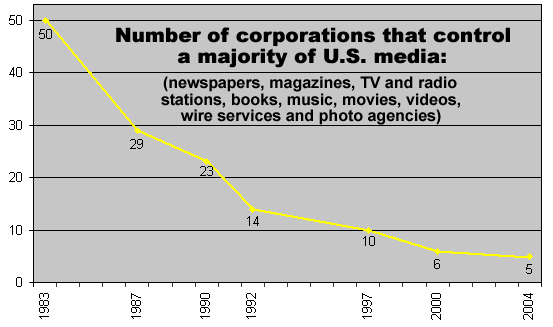
And the corporate controlled media simply cheerleads the whole thing, convincing most people it's all been for their own good.
 Make America Great
7
Sisters
Of
Institutional Change
1.)   End the Federal Reserve
2.)   Repeal 17th Amendment – Reinstate Federal Senators chosen by State Legislators.
1. Term Limits – Constitutional Amendment
A. Two six year terms for Senators
B. Three terms House of Representatives
3.)   Repeal 16th Amendment – Income tax replace with value added tax.
4.)   Pass the Balanced Budget Amendment
5.)   Exit the United Nations
6.)   Reign in the Medical Industrial Complex
a. Enforce Anti-Trust Laws
b. Pass Legislation for re-importation of ethical drugs
7.)   End Federal and Private Student Loans
DYI