Tuesday, December 8, 2015

When will Governments Learn?...Never??...R&D Money in the Private Sector is with the Consent of Investors, Governments Mandate the Money from their Taxpaying Citizens.

Abengoa: Another Story Of Sudden Insolvency

Although the media and many experts blame the crisis and the squeezing of the renewables industry for Abengoa’s problems, this is in fact not true. In the first place, we cannot describe Abengoa as a renewables company. Besides being involved in renewable electricity generation and converting biomass into biofuel, it is also one of the world’s leading power lines builders and a top engineering and construction firm. It employs 24,000 people worldwide. 
And, although several of its businesses lines have been suspended in Spain, we mustn’t forget the company gets 84% of its income from abroad. The Andalucian company has amassed dozens of very important infrastructure projects in the past few years all over the world, from the U.S. to China and Latam. The problem is that with a  gross debt pile of some €8.9 billion, and exposure to Spanish and international banks of around €20.2bn, Abengoa has found, and continues to find it difficult to get them off the ground. It lacked the financial resources, and the banks did not lend any more. The company has a special business model. Instead of simply building projects or running them, it does both, raising money from bond markets to finance expansion. 
Another person who didn’t expect such a terrible outcome is Obama. His administration awarded the company about $2.7 billion for two majors projects — the Solana Generating Station in Arizona and the Mojave Solar Project in California. Republicans and other critics of renewables were short of time to remind Obama of his previous failure with Solyndra in 2011. This left taxpayers responsible for more than $530 million. These people reminded the President that the administration’s meddling in the energy sector leads to disaster for taxpayers.
DYI Comments:  Governments whether on the right or the left need to get out of the business of attempting to pick winners with the newest technologies.  What the government is excellent at core research that individuals and corporate R&D departments can tap into to develop potential products. Many of course will fail just as the government has.  However, private money is obtained by consent of their investors as opposed to taxpayers that is mandated.  Core research I have no problem with and to a point encourage the government to do more.  Leave the development of products to the corporate R&D departments in risking their money and besides due to the profit motive they are far better prepared for the rigors of high risks development projects.
DYI

Monday, December 7, 2015

Historical similarities in negativity between Stocks and Commodities

I would remind you that when you look at the bull market in stocks between 1982 and 2000 there were several times when stocks collapsed. In 1987 stocks went down 40 – 80% around the world. There were several times when prices collapsed and everyone said the bull market was over but it wasn’t. 


Is the bull market over in commodities? I don’t think so. But maybe I’m wrong, it started a long time ago.

DYI Comments: DYI doesn't believe the run is over as well.  However I'll use our formula based asset allocation based on valuations and leave my guesses and emotions out of the process.
DYI
December 7, 2015

John P. Hussman, Ph.D.

On the basis of valuation measures most closely correlated with actual subsequent 10-12 year S&P 500 total returns in market cycles over more than a century, a ranking of the most overvalued extremes in U.S. history, in order of severity, includes: 
2000, 2015, 1929, 2007, 1937, 1907, 1968, and 1972. 
While the 1969-70 retreat took the S&P 500 down by only one-third of its value, each of the other instances was followed by market losses of 50% or more over the completion of their respective market cycles. Given that 2015 is the second highest valuation extreme on record, such an outcome is not some worst-case scenario, but is instead a rather run-of-the-mill expectation. 
Notably, the 2000 market peak was dominated by large-capitalization stocks and the technology sector. The recent Fed-induced speculative bubble actually brought the valuation of the median stock beyond the 2000 extreme, marking the most offensive point of overvaluation in history for the broad market. 
A 50% market loss would not even bring the most historically reliable valuation measures materially below their long-term averages.
DYI Comments:  Today as measured by the average dividend yield going all the way back to 1871 is 4.40%.  Converting to (PD) price to dividends [ 1 / 4.40 = 23 (rounded) ] is 23 to 1.

Currently today the markets price to dividend ratio is 49 to 1 (or 2.03%).  Applying simple arithmetic the market as measured by dividends is trading 113% above its historical average [ ( 49 - 23 ) /23 x 100 = 113% ]. This is from average PD to where we are now!  Bargains are when asset prices are trading below their historical norms.  The U.S. stock market is clearly massively overvalued. Expectations from these extreme levels of a 50% decline (DYI is 45% to 60%) would be as John Hussman states: RUN OF THE MILL MARKET DECLINE!

DYI's weighted averaging formula that increases your allocation proportionally greater when values are below their average and decreases you proportionally greater when values are above the average. It is as simple as that.  Currently today valuations are so high our formula has "kick us out" (for good reason) of the stock market.  DYI are NOT market timers; DYI weighs the market.  Slowly increasing or decreasing your percentage allocation as determined by the degree of over or under their valuation average.  These changes take years to complete a market cycle from peak to peak or trough to trough.  DYI includes three other assets gold (precious metals mining companies), long term high quality bonds (gov't & corporate) and short term bonds (cash).  All four are highly correlated to the economy and greater than 3 to 5 year periods of time UNCORRELATED to each other.

THERE'S A BULL MARKET SOMEWHERE

Within a 3 to 5 year time period one(sometimes two) of the three assets, stocks, Lt. bonds or gold will be in a bull market.  Cash or short term bonds is simply are holding area until valuations of the other three become worthy with greater valuations.

Currently today gold mining companies share prices have been decimated!  The mining industry is not going to disappear.  They will close marginal mines, buyouts & mergers, consolidating the industry back into profitability.  Over the short to intermediate term (2 to 5 years) share prices will be hammered.  This sets up an excellent time to dollar cost average into your favorite precious metals & mining fund at very low prices.
Vanguard Precious Metals and Mining Inv (VGPMX)
Above is Vanguard's Precious Metals & Mining Fund symbol VGPMX has been decimated with the makings of a bargain.  The macro basis our proxy for determining percentage asset allocation is the DOW/GOLD RATIO which has regressed back to its mean.


Neither expensive nor an outright bargain hence our 22% level for our allocation model.

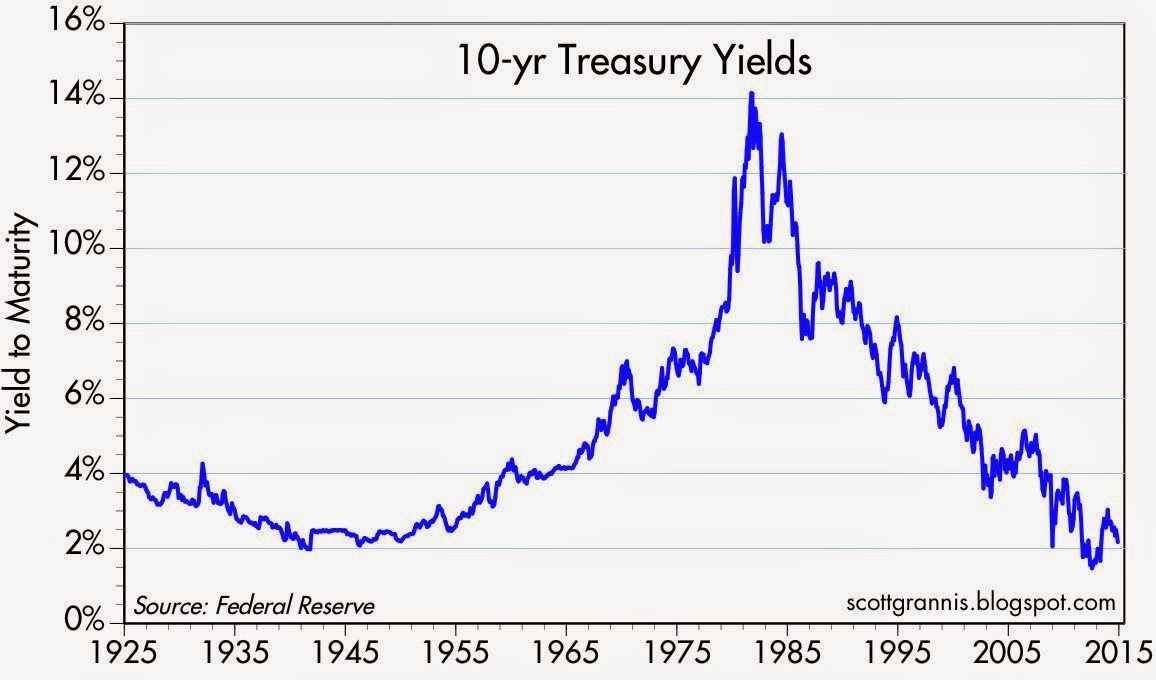
Long term bonds as measured by our proxy the ten year Treasury bond our formula has "kick us out" of that market as well and rightfully.  Unless an individual has been living in a cave everyone who is a saver in some form or fashion has been infuriated with these sub atomic low interest rates.  They are so low (DYI's opinion) no longer merit investment consideration due to their excessively long duration.

So here we sit with our cash horde and only until recently have put a little extra to use in the gold column (VGPMX).  The Great Wait Continues....Just as you think nothing is going to change the economy/valuations will change surprising everyone except the value players here at DYI. 
Updated Monthly

AGGRESSIVE PORTFOLIO - ACTIVE ALLOCATION -  12/1/15

Active Allocation Bands (excluding cash) 0% to 60%
78% - Cash -Short Term Bond Index - VBIRX
22% -Gold- Precious Metals & Mining - VGPMX
 0% -Lt. Bonds- Long Term Bond Index - VBLTX
 0% -Stocks- Total Stock Market Index - VTSAX
[See Disclaimer]

 This blog site is not a registered financial advisor, broker or securities dealer and The Dividend Yield Investor is not responsible for what you do with your money.
This site strives for the highest standards of accuracy; however ERRORS AND OMISSIONS ARE ACCEPTED!
The Dividend Yield Investor is a blog site for entertainment and educational purposes ONLY.
The Dividend Yield Investor shall not be held liable for any loss and/or damages from the information herein.
Use this site at your own risk.
PAST PERFORMANCE IS NO GUARANTEE OF FUTURE RESULTS.
DYI

Sunday, December 6, 2015

Hugo Salinas Price
In the last fifteen months, from August 1, 2104 to November 27, 2015, International Reserves, as calculated by Bloomberg, have fallen three-quarters of a trillion ($752 billion) dollars, or 6.52%. International Reserves peaked at $12.032 Trillion on August 1, 2014, and have fallen since then to $11.28 Trillion on November 27, 2105. 
Central Banks increase their Reserves by purchasing Government Bonds - denominated in Dollars, Euros, Pounds or Yen - when those currencies come into their hands as a result of a surplus of exports over imports; all countries strive to have such surpluses, because if they are not able to export more than they import, then they are condemned to devalue their currencies in order to make their exports more attractive; they are also burdened with higher interest rates on their borrowings, as a result of the threat of further devaluation. Higher interest rates in turn, exacerbate the outflow of Reserve currencies and make devaluation all the more necessary.
 China's Yuan has recently been accepted by the IMF, to form a part of its "basket of currencies" and as of Oct. 1, 2016 the Yuan will be anointed as a Reserve Currency by the IMF. When that happens, China will have its own Reserve Currency, and less need to maintain its present enormous pile of Reserves in Dollar and Euro Government Bonds. So the sell-off of International Reserves might become even stronger. The Fed and the ECB have enjoyed selling Bonds at ever higher prices and ever lower interest rates, so low that in Europe these Bonds have a negative yield. They will have to develop an appetite for Bonds, because China is going to send a bunch of them back to the sellers when the Yuan achieves Reserve Currency status. As China liquidates a portion of its Reserves, guess what China is going to buy with the Dollars and Euros it receives for its Dollar and Euro Bonds? 
China is quietly accumulating gold and saying nothing. But we can try to guess what China is thinking: "The US is mired in an insoluble problem. Do nothing to provoke the US. The US will destroy itself in a huge collapse." 
China will then say to the world: "We sell cheap. Very cheap. But, we sell for gold, for very little gold; and we pay with gold for what we buy - for very little gold, but we pay gold. You want our stuff, you find a way to pay us in gold. Or else, what do you have to offer us, in exchange for our stuff? You have something we want - we pay in gold. Rest of the world, do as you please." 
The nations of the world are not going to flounder endlessly in the crisis that is upon us. Out of the huge crisis, China will break away and state its terms. And the terms will be: GOLD. The rest of the world will follow.
DYI 

Saturday, December 5, 2015

It Will Take Trillions of Euros to Save the European Union

Before the euro was created, the economist Robert Mundell wrote about what made for an optimal currency area. His work was so important that he won a Nobel Prize for it. He wrote that a currency area is “optimal” when it has:
  • Mobility of capital and labor,
  • Flexibility of wages and prices,
  • Similar business cycles, and
  • Fiscal transfers to cushion the blows of recession to any region. 
Europe has almost none of these. Very bluntly, that means it is not a good currency area. 
The European story can end only two ways. 
Either member nations will reforge the Eurozone as a true political union, or it will break up. 
There is really no middle ground.
DYI Comments:  If the U.S. experiences a deflationary smash(severe recession) generating a world wide recession with pockets of depressed countries a high probability that the Euro will cease to exist. As it stands currently England is trading far more with Asia than the continent of Europe even a mild U.S. recession maybe enough for her to "pull the plug" and exit the union.

Most likely the trade agreements will remain as each country abandons the Euro replacing it with their home currencies.  I find it highly unlikely that a United Europe will be formed.  There is simply too many differences in culture, languages, and geography to pull them together into a Federalist system.
DYI


Friday, December 4, 2015

“Distress” in US Corporate Debt Spikes to 2009 Level

Bonds are “distressed” when prices have dropped so low that yields are 1,000 basis points (10 percentage points) above Treasury yields. The “distress ratio” is the number of non-defaulted distressed junk-bond issues divided by the total number of junk-bond issues. Once bonds take the next step and default, they’re pulled out of the “distress ratio” and added to the “default rate.” 
At the lowest end of the junk bond spectrum – rated CCC or lower – the bottom is now falling out. Yields are spiking, having more than doubled from 8% in June 2014 to 16.6% now, the highest since August 2009:
US-CCC-or-below-rated-yields-2011_2015-12-01
This is what the end of the Great Credit Bubble looks like. It is unraveling at the bottom. The unraveling will spread from there, as it always does when the credit cycle ends. Investors who’d been desperately chasing yield, thinking the Fed had abolished all risks, dove into risky bonds with ludicrously low yields. Now they’re getting bloodied even though the fed funds rate is still at zero!
DYI Comments:  If the Fed's actually increase rates they will have to do a 180 continuing their sub atomic low rates.  If we experience a deflationary smash don't be surprised when the 30 year Treasury trades below 2% and the 10 year Treasury below 1%.  Treasury notes of 5 years or less will go to negative interest rates in that scenario.

Updated Monthly

AGGRESSIVE PORTFOLIO - ACTIVE ALLOCATION -  12/1/15

Active Allocation Bands (excluding cash) 0% to 60%
78% - Cash -Short Term Bond Index - VBIRX
22% -Gold- Precious Metals & Mining - VGPMX
 0% -Lt. Bonds- Long Term Bond Index - VBLTX
 0% -Stocks- Total Stock Market Index - VTSAX
[See Disclaimer]
DYI with our cash horde will easily be sustained any market shakeout.

DYI

Thursday, December 3, 2015

Is Russia Experiencing the Domino Effect as her Allies Switch Sides??...Is Serbia Next Ending Russia's influence in the Balkan's??

AP EXPLAINS: Montenegro's Bid to Defy Russia, Join NATO

   
NATO is seeking to expand for the first time after six years by inviting the tiny Balkan nation of Montenegro to join the alliance. The move on Wednesday angers Russia, which has strong historic, political and cultural influence in Montenegro and is threatening economic and political retaliation. Here's a brief explanation of how global tensions play out in Montenegro, where the people remain deeply split over whether to join the Western military alliance that bombed the country in 1999. 
THE BLACK MOUNTAIN ON THE SEA 
Montenegro — which means "Black Mountain" — is a small country in southeast Europe. It is a land of stunning natural beauty, squeezed between the Adriatic Sea and towering mountains, laced with green valleys and rushing rivers. The land area is nearly 14,000 square kilometers (5,300 square miles). Just over 600,000 people live in Montenegro, mostly in the capital Podgorica and along the coast. The economy is weak, relying largely on tourism. 
A MOSTLY CHRISTIAN NATION WITH A COMPLEX HISTORY 
About 70 percent Montenegrins are Orthodox Christians, which partly explains strong links to Russia, also a predominantly Orthodox Christian country. Until recent history, Montenegro had been a faithful ally of Russia in the Balkans, so much so that it is said to have declared a war on Japan in 1904 just to support Russia in its clash with Japan. Montenegro was also a rare country in the region to have retained a level of autonomy during centuries-long Turkish Ottoman rule.
Montenegro has a small army of just some 2,000 soldiers, but it is strategically located on the Adriatic sea, between NATO members Croatia and Albania, 
having deep-water navy bases that could be used for big navy ships and submarines. 
Bringing in Montenegro to the NATO sphere further diminishes Russia's influence in southeast Europe, and blocks it from the so-called "warm seas" in Europe. 
The Russians are not so much worried about the strategic military loss, but more about their diminishing political influence on the region.
Montenegrins are almost equally divided over joining NATO. Pro-Russian opposition parties are already demanding a referendum before the entry is formalized next year — mirroring demands by Russian officials. This could lead to tensions after recent anti-NATO protests in the capital Podgorica which have turned violent. Still, pro-Western Prime Minister Milo Djukanovic insists Montenegro's invitation is good news for the country and regional stability. Montenegrin analysts believe Russia will try to finance the Montenegrin opposition ahead of the next general election scheduled for the next year, to try to unseat Djukanovic's government before Montenegro formally becomes a NATO member. The latest opinion poll conducted by the local Damar agency said that 47 percent of Montenegrins are in favor of the NATO bid, some 39 percent are against while 14 percent are undecided. The poll has a two percent margin of error.
DYI Comments:  If Montenegro is confirmed into NATO it will be a small victory for U.S./NATO/EU and a huge loss of status for Russia plus denying them any possibility of a naval base in the Adriatic Sea.  No doubt Russia will throw resources to the opposition party just as the U.S./NATO/EU alliance will back Prime Minister Milo Djukanovic. This invitation into NATO has most likely be into play for sometime, however, with Putin Russian hierarchy conducting bombing missions supporting Assad in Syria, the time table may have been advanced.

The U.S. continues in its march to isolate Russia by stripping away her allies and bring them within the sphere of the U.S./NATO/EU alliance and institutions.  The proximity of Montenegro to Russia from the Black Sea is closer than one would suspect.
  
The U.S. had its domino theory of communism during the first Cold War now in its second Cold War the Russian now have their domino theory working as well.  Is domino Serbia the next to fall?  If that were to happen it would be a major blow to Russian prestige ending any influence (to a significant degree) in the Balkans.  Further limiting Russia's naval access to the Mediterranean and furthering the long term strategic U.S./NATO/EU goal of  eliminating Russia's Black Sea Fleet.

Who Doesn't Love Beach Front Property?
   DYI    

Don't be Fooled by Lower Oil & Gas Prices...The Hydrocarbon Cold War is Heating Up!

The Hydrocarbon Cold War

'Large' Chinese military fleet flies near Japan islands: media

Japan scrambled jets after 11 Chinese military planes flew near southern Japanese islands during what Beijing said was a drill to improve its long-range combat abilities, reports said Saturday. 
The planes -- eight bombers, two intelligence gathering planes and one early-warning aircraft -- flew near Miyako and Okinawa on Friday without violating Japan's airspace, the Japanese defence ministry said in a statement released on Friday.
A Chinese air force spokesman said several types of planes, including H-6K bombers, were involved in Friday's drill over the western Pacific, China's Xinhua news agency reported.
 

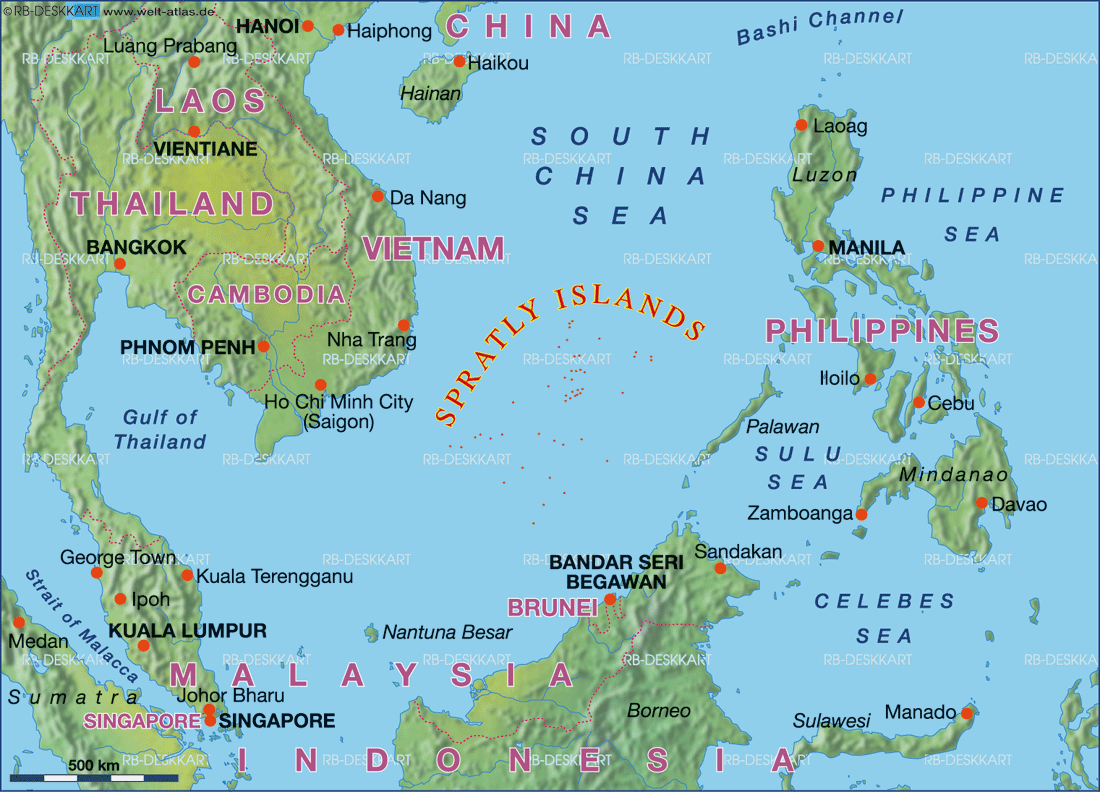
DYI Comments:  China is pressing its new found economic might with a built up of their military to expand their presence in the Yellow Sea, Sea of Japan, East and South China Sea. Expanding their footholds for influence/intimidation of minor countries in order to extract their natural resources especially oil and gas.  The Spratly Island chain of known oil & gas reserves is now hotly contested by Vietnam, Philippines, and China.  Of course anyone looking at a map would find it preposterous China having any claims.  Hence China's built up of military forces.

The U.S. response is the Asian pivot from Europe.  However it has been delayed by the reemergence of Russia and their pivot to Asia(China) with their pipeline projects supplying oil & gas.
 
To understand the U.S. domestically and internationally is our State Departments five primary goals. These are stated in George Friedman's book The Next 100 Years (pages 40-46).

1.)  The complete domination of North America by the United States Army.
2.)  The elimination of any threat to the U.S. by any power in the western hemisphere.
3.)  Complete control of the maritime approaches to the U.S. by the Navy in order to preclude any possibility of invasion.
4.)  The complete domination of the world's oceans to further secure U.S. physical safety and guarantee control over the international trading system.
5.)  The prevention of any other nation from challenging U.S. global naval power.

Where does the war on terror fit into matrix's?  It doesn't.  The war on terror has been a side show from day one, as long as they don't obtain weapons of mass destruction(biological, chemical, nuclear).  Don't get me wrong our government has placed large resources to insure our safety.  Some have been effective and others have been outrageous amount of wasted money.  To repeat; the war on terror is a side show.

Goal number five is where we are today.  In order to prevent any nation from challenging U.S. global naval power has embark upon breaking up our two largest international competitors: Russia and China.  Russia has two principal ports with access to the Atlantic Ocean.  The first is ST.
Petersburg access to the Atlantic via the Baltic Sea.  The U.S. is very, very good friends with Denmark as Zealand Island is a major choke point for all naval transports embarking to and from the Atlantic.  No Russian ship merchant marine or naval ship only proceeds by U.S./Danish permission.


The second principal access to the Atlantic Ocean is far more convoluted for Russia, the Black Sea through the Bosporus Straight controlled by Russia's mortal enemy Turkey, into the Sea of Marmara and through the long narrow channel of Dardanelles, into the Aegean Sea, only to make to the Mediterranean Sea.
If Russian naval ships want to leave the Mediterranean it is through two more choke points, the Suez canal or past British Gibraltar in southern Spain.  Gibraltar is not as militarized as it once was however if the Russian were to have easier access to the Med that would change quickly with English and American support.

The Russians have two secondary ports that are on top of the world.  Murmansk on the Barents Sea and Arkhangel'sk by the White Sea that empties into the Barents Sea as well.  The costs to develop these ports is horrendous as these cities are far away from the industrial areas of Russia thereby everything needs to be ship in by rail or motor transport.  The winters are long and brutal for Arkhangel'sk and beyond imagination for Murmansk shortening the construction season.  The Barents Sea is noted for its fierce storms sinking more ships there than many naval battles.  All and all even for Russians a most horrific place in the world for surface ships.  Russian submarines have done reasonably well porting in Arkhangel'sk but even during the height of the cold war the logistics/costs were simply too overwhelming to build the amount of subs needed to project power in this harsh climate.
That leaves Russia's access to the Pacific their principal port of Vladivostok located on the Sea of Japan.  This city is Russia's Seattle Washington as far as they are concerned.  The latitude is closer to Portland Oregon making it very livable; warm water all year around port; and a thorn in the backside of U.S. Naval power(at least in the Pacific).
 
Russia suffered for the longest time a logistics problem of Vladivostok being extremely far away from their industrial centers but with the rise of China those logistics lines have been shortened.  Not only by traditional rail transport, heavy lift capabilities by ship from many of the industrial centers of China.  Russia pays for these basic needs through their oil and gas sales to China.  This is Russia's pivot to Asia.  The only negative is tactical, Russian ships are hemmed in by Japanese and South Korean land based air units and naval power supported by the ever present U.S. flotilla stationed in Japan. Nevertheless, Vladivostok continues to this day a thorn in the U.S. Navy's backside.

Since the end of the cold war and the fall of the Soviet Union the U.S. has followed a plan of expanding NATO along with admission or integration into the European Union.  As we added military bases in those countries Russia is surrounded.

As Europe pushed for the Ukraine to enter the trade agreements with the EU along with the possibility of becoming a NATO member Russia reacted.  The Russian hierarchy easily saw the trap door being closed on the Russian Caucasus' brought under the sphere of Turkey/U.S./NATO/EU trade agreements(along with Azerbaijan oil/gas).
   If this trap door was to close NATO/U.S./EU the distance to Volgograd a principal city of Russia to the Ukraine border town of Luhansk is 461 kilometers or 286 miles. This conjures up to the same basic degree as our Cuban missile crises as the Soviet placed conventional/nuclear missiles on that island nation only miles away from Florida.  Unacceptable to the U.S. and that possibility unacceptable to the Russians.
   The biggest reason that NATO/U.S./EU is attempting to close the trap door the Russian Black Sea Fleet would be eliminated.  This is why Putin has made a grab for the Ukrainian Crimean peninsula with its major port facilities at Sevastopol.  Plus making a play for the rest of the Ukraine for their port facilities at Odesa.

The U.S./NATO/EU continue in their attempt to strip away allies of Russia.  Putin along with the Russian hierarchy are projecting power and attempting maintain their ally Syria.  The U.S. wants a regime change to a pro U.S./NATO/EU country further eroding Russia which would only encourage Turkey/U.S./NATO/EU into the Caucasus.

Breaking Up Russia to Control China 

By having Russia expend vast resources in manpower/military equipment/and large amounts of money exhausting themselves to where the vastly underpopulated east breaks away from Russia.  The attempt to put in a pro U.S. controlled government(s) from the Ural Mountains eastward.
  

By the U.S. controlling the oil/gas pipelines into China they will have to do our bidding or go to war.

Unfortunately war drums are already beating as China expands in her need of oil and gas to continue propelling their economy forward.  Just as Russia plays the hydrocarbon cold war card with Europe, the U.S. is positioning to play the same game by controlling Russia's far eastern regions with China.

The U.S. and her allies are in the process of supplying LNG (liquefied natural gas) into the Netherlands port of Rotterdam reducing Russia's hold(and hard currency) over natural gas sales to Europe.

Currently Russia is ahead by supplying Europe and China with oil/gas/other natural resources but the huge geopolitical game is afoot.  Here is how the U.S./NATO/EU game plan is evolving.

1.)  Strip away allies of Russia with pro western governments supportive of U.S./NATO/EU institutions.
2.)  Expand NATO whenever possible.  Southern high valued countries Ukraine & Moldova, Georgia, Kazakhstan, Mongolia.  Northern independents Sweden and Finland plus southern independents Austria and Switzerland(not a chance).  Belarus and Serbia are staunch allies of Russia, a long shot at best.  
3.)  Deprive Russia of hard currency sales of natural gas to Europe by exporting LNG to Rotterdam.
4.)  Manipulate lower prices for oil & gas whenever possible depriving Russia hard currency and propelling western economies forward. 
5.)  Engage Russia into proxy wars exhausting herself of men, material, and financially with armies and land based air units.  Thus depriving men, material, and monies for her navy.
6.)  If successful remaining portion of Russia incorporated into U.S./NATO/EU institutions.
7.)  Aggressively pivot to Asia.
8.)  Put into place steps to breakup China
9.)  Reduce China's naval presence to a coast guard level.


DYI  

Tuesday, December 1, 2015

EYC Ratio Falls to One...Time to Re-Think Stock/Bond Allocation???....The Stock Merchandise is in Dead Heat with Bonds Next 10-12 Years...5 Years or Less Caveat Emptor...Expect 45% to 60% DECLINE for Stocks!

Margin of Safety!


Central Concept of Investment for the purchase of Common Stocks.
"The danger to investors lies in concentrating their purchases in the upper levels of the market..."

Stocks compared to bonds:
Earnings Yield Coverage Ratio - [EYC Ratio]

EYC Ratio = [ (1/PE10) x 100] x 1.1] / Bond Rate
1.75 plus: Safe for large lump sums & DCA
1.30 plus: Safe for DCA

1.29 or less: Mid-Point - Hold stocks and purchase bonds.

1.00 or less: Sell stocks - Re-balance portfolio - Re-think stock/bond allocation.

Current EYC Ratio: 1.02
As of 12-1-15
Updated Monthly

PE10 as report by Multpl.com
DCA is Dollar Cost Averaging.
Lump Sum any amount greater than yearly salary.

PE10  .........26.30
Bond Rate...4.12%

Over a ten-year period the typical excess of stock earnings power over bond interest may aggregate 4/3 of the price paid. This figure is sufficient to provide a very real margin of safety--which, under favorable conditions, will prevent or minimize a loss......If the purchases are made at the average level of the market over a span of years, the prices paid should carry with them assurance of an adequate margin of safety.  The danger to investors lies in concentrating their purchases in the upper levels of the market.....

Common Sense Investing:
The Papers of Benjamin Graham
Benjamin Graham

Since the Year 2000 Gold vs the Nasdaq Lopsided Returns 15 Years Later....Beware of Buying Overvalued Markets(just like 2000)...We are Now into Our Third Stock Market Bubble! Buyer Beware!

12-1-15
Updated Monthly

Secular Market Top - Since January 2000

+  54.1% Dow       
+172.1% Transports 
+  98.7% Utilities

+41.6%  S&P 500
+25.5%  Nasdaq

+53.9%  30yr Treasury Bond

+268.0% Gold
  +62.7% Oil

From High to Low

+268.0% Gold
+172.1% Transports
+  98.7% Utilities 
+  62.7% Oil
+  54.1% Dow
+  53.9% 30 Year Treasury 
+  41.6% S&P 500
+  25.5% Nasdaq

It is easily seen that in the year 2000 the Nasdaq was horribly overvalued and gold was on the give away table, such lopsided returns 15 years later!

Also of interest the stodgy 30 year Treasury bond has outperformed the Dow(until just recently), S&P 500, and the Nasdaq since the year 2000.  The modern portfolio crowd back in the year 2000 would find this a very low probability outcome.  Value player's, due to extreme valuations, would have recognized this as the most likely outcome (close to a no-brainer!).