Wednesday, December 23, 2015


John P. Hussman, Ph.D.
As the Fed drove the monetary base to the most extreme level in history, the “reach for yield” didn’t stop at Treasury bills. With over $4 trillion in hot potatoes steaming uncomfortably in the hands of investors, they reached for yield in riskier securities (just as similarly uncomfortable investors chased mortgage securities during the housing bubble). This drove up demand for junk debt, leveraged loans, and equities, all of which became the beneficiaries of reckless but ultimately temporary yield-seeking speculation.


What makes this nearly beyond belief is that encouraging this yield-seeking speculation was one of Ben Bernanke’s intentional objectives. That’s not economics, it’s sociopathy.

How to Tell a Sociopath from a Psychopath

Sociopaths tend to be nervous and easily agitated. They are volatile and prone to emotional outbursts, including fits of rage. They are likely to be uneducated and live on the fringes of society, unable to hold down a steady job or stay in one place for very long. It is difficult but not impossible for sociopaths to form attachments with others. Many sociopaths are able to form an attachment to a particular individual or group, although they have no regard for society in general or its rules. In the eyes of others, sociopaths will appear to be very disturbed. Any crimes committed by a sociopath, including murder, will tend to be haphazard, disorganized and spontaneous rather than planned. 
Psychopaths, on the other hand, are unable to form emotional attachments or feel real empathy with others, although they often have disarming or even charming personalities. Psychopaths are very manipulative and can easily gain people’s trust. They learn to mimic emotions, despite their inability to actually feel them, and will appear normal to unsuspecting people. Psychopaths are often well educated and hold steady jobs. Some are so good at manipulation and mimicry that they have families and other long-term relationships without those around them ever suspecting their true nature.
DYI 

Monday, December 21, 2015

For Caterpillar, The Depression Just Turned Three: CAT Hasn't Had A Sales Increase In 36 Consecutive Months

Earlier today Caterpillar reported its latest monthly retail sales statistics, and the numbers continue their deplorable trend: 
Asia/Pacific (mostly China) was down -17%,EAME dropping -5%, Latin America down -37%, the US down -5%. 
Global sales continuing their double digit decline for one more month down -11% in November.
DYI Comments:  The world economy is slowing down and is dancing on a pin from going into a world wide recession.  U.S. stock and bond (especially junk) are horribly overvalued.  The only reason prices continue to be elevated is the declining price of oil that has put a bit of zip into the U.S. economy keeping it from going straight back into recession.  Nevertheless with valuations elevated to the extreme any economic mishap will change market participants perception to a risk off mentality. Dropping markets irregardless of current oil prices.

DYI's model portfolio remains extremely conservative due to massive overvaluation.

 Updated Monthly

AGGRESSIVE PORTFOLIO - ACTIVE ALLOCATION -  12/1/15

Active Allocation Bands (excluding cash) 0% to 60%
78% - Cash -Short Term Bond Index - VBIRX
22% -Gold- Precious Metals & Mining - VGPMX
 0% -Lt. Bonds- Long Term Bond Index - VBLTX
 0% -Stocks- Total Stock Market Index - VTSAX
[See Disclaimer]

Ukraine...Three Nation Flash Point....China, U.S/NATO, Russia

Cultivating Ties: Ukraine Feeds China's Growing Appetite For Crops

The 16-month-long conflict with pro-Russian separatists in the east has not only cost more than 6,400 lives, but left much of the heavy industry there either shuttered or operating at less than full steam. Overall, the economy shrank nearly 7 percent last year and is projected to do even worse in 2015. The country’s currency, the hryvnya, has dropped more than 70 percent against the U.S. dollar since early 2014. 
Despite that, Ukraine’s total crop production in 2014 reached 63 million tons, a post-Soviet record, and agricultural officials are hoping to come close to that this year. 
The bumper crops should come as no surprise for a country once dubbed Europe’s “breadbasket” due to the bountiful harvests cultivated on fertile lands known as “black soil.” Ukraine has about 32 million hectares of arable land, about one-third as much as in the entire European Union. 
Ukraine is also a piece of Beijing’s grander puzzle to develop a new trade route from China to Europe, according to Gale. 
"China has a strategy to raise its profile in global economics and politics. Part of that is its new Silk Road or also known as ‘One Belt, One Road’ strategy. And that involves strengthening economic relations with various countries between China and Europe, including Ukraine,” he said.
**************************
**************************
 Chinese Hongdu L-15
Ukraine plans to launch the assembly of Chinese Hongdu L-15 light attack aircraft at an Odesa-based facility in 2016, a Ukrainian weekly has reported; discussions on the project are in their final stages. The manufacturing will be performed at Odesa’s Odesaviaremservis, a subdivision of the state’s Ukroboronprom defense complex (Delovaa Stolitsa, November 23). The L-15 is a licensed copy of the latest Russian combat trainer, the Yak-130. 
It remains to be seen whether the China-Ukraine Hongdu light attack aircraft contract is the precursor of deeper Chinese-Ukrainian armaments relations. Nevertheless, this deal represents a first in that China is not only developing joint production of weaponry in the post-Soviet space, but it is explicitly dealing with a country in Russia’s self-proclaimed “sphere of privileged interest” with which Russia has poor relations. As a major supplier of energy to China, Russia has some cards to play if it starts to see China’s relationship with Ukraine as a threat. But utilizing those pressure points could come at a substantive economic cost to Russia at a time of record low global energy prices, combined with the European Union’s efforts to diversify away from Russian energy imports. 
Accordingly, it seems likely that Russia will, for the moment at least, grudgingly tolerate the Hongdu contract while carefully monitoring any deepening development of Ukrainian-Chinese joint armaments production.
DYI 

Why Are Drug Monopolies Running Amok? Meet Deborah Feinstein

One of the biggest policy debates in America today concerns the unparalleled rise in prescription drug costs. Enormous pharmaceutical industry profit margins; tales of companies like TuringValeant, and Gilead Sciences jacking up the price of life-saving medicines; and a spate of industry mergers (the latest being a $150 billion deal between Pfizer and Allergan, designed mostly to lower their tax rates) have lawmakers and presidential candidates scrambling for answers.
DYI Quick Comment (1):  Biggest policy debates?  Rarely presidential contenders discuss the mad dash of not just big pharma but of the consolidation  of the entire medical industry.  Their campaign dollars are immense so its mum's the word or quickly change the subject such as the war on terror. 
But one point has been lost among the various proposals: The U.S. has had antitrust laws on the books for over 100 years to reduce the power of monopolies and restrain consumer costs. They could come in handy in situations like these.
 DYI Quick Comment (2):  You bet we do:  Sherman Anti-Trust Act of 1890...The Clayton Antitrust Act of 1914...The Robinson–Patman Act of 1936...All designed to put an end to consolidation and anti competitive pricing schemes notorious for hospitals/pharma etc.
Bernie Sanders recognized this when he urged the Obama administration to block the Pfizer-Allergan merger. Hillary Clinton has promised to “stop corporate concentration” in the pharmaceutical industry.
DYI Quick Comment (3):  Hillary Clinton "promised" to end corporate concentration??  She is a big government /  big business politician from day one.
The problem is that the federal agency responsible for antitrust oversight of drug companies — the Federal Trade Commission — has a terrible track record of supporting the public interest. 
 And the reason why can be seen in the career trajectory of one woman: Deborah Feinstein, director of the FTC’s Bureau of Competition, the agency’s main enforcement entity. During Feinstein’s tenure, the FTC has largely abandoned its attempts to block mergers, instead favoring consent agreements that have a history of failing to achieve their goals. 
DYI Quick Comment (4):  Deborah Feinstein is just one of many who have either failed or mislead the public into thinking they are protecting the public from monopolies or oligarchs.  It becomes a bit of a hit piece against Mrs. Feinstein where as the FTC (and many other government agencies) have become a revolving door for years between corporate lawyers representing the medical industrial complex and their representative government agencies.

The Solution:  Only until it becomes common knowledge and political will from the people will these problems be addressed.  The seeds of this change have already been planted with the Millennial generation as they are now forced by law to purchase an inflated insurance scheme designed to keep the party (revenues) going for the medical industrial complex.  As these prices sky rocket Millennials will dig in their heels for change.  This will occur as they become older and obtain political power as a voting block electing their leaders of the same mind set.

In a prior post I addressed how the U.S. oscillates from pro business to pro labor as currently we are in the turning phase. These articles ( I hope to see many more) will build that necessary consensus to the critical mass level; once achieved massive change will occur benefiting our citizens (labor).

Free enterprise will solve these high prices once the pro labor movement surges forward dissolving crony capitalism.  But alas two or three decades (from the time pro labor is firmly in place) the cost of labor will become wildly over priced and we will enter into the turning phase back to pro business. This yin and yang for business and labor has been going on since the first arrivals to America.  
DYI

Sunday, December 20, 2015

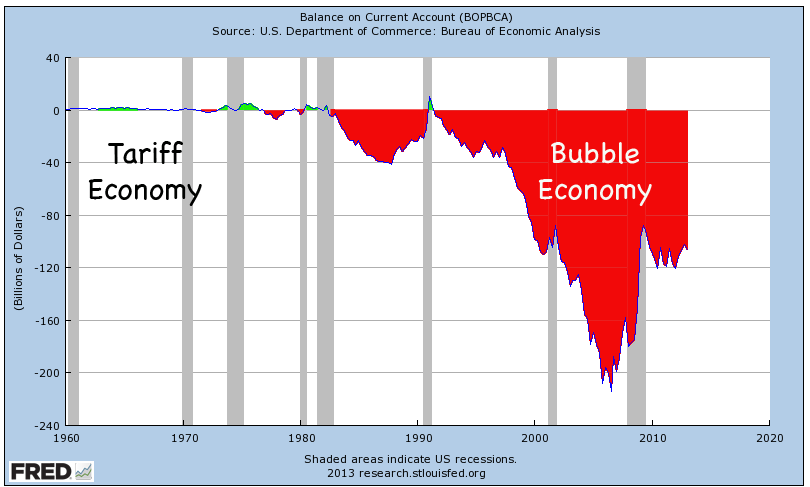
U.S. Trade Deficit, Bubble Economy, America's Future.


The USD$ will continue its long-term secular pattern of weakening (with occasional corrections) until the trade balances meaningfully go positive for an extended period. Without a much lower long-term USD$, I’m not sure how the US can realistically achieve a larger export sector as a percent of GDP. The peak of the US export sector was ~1970, coinciding with the peak of the US dollar.
Currency relative valuations, over the long term, always come to reflect long-term accumulated trade balances. Currency weakness, over the long term is the market’s way of indicating that trade deficits need to be balanced out. In the long term, the economy will allow no nation to be perpetually either a debtor nor a creditor. 
Its sort of like a slow motion chronic illness, such as a slow growing cancer. Every so often, it might go into remission. But the long term trend is death, just as it is for the US dollar on account of long-term trade deficits. Until, of course, they get their proverbial act together, which probably will be forced upon them by crisis. 
The (perceived) necessity of raising US policy rates to quell future inflation (devaluation). The increasing run on US treasury debt by foreign investors. The US CPI figures which actually came in quite a bit higher than I anticipated (especially compared to Canada which is at 1% YoY despite a 30%+ devaluation against our largest trading partner). The US’s shrinking prominence in the world. Declining living standards in the US. If you can’t add this all up and see the trend unfolding, well, there’s no hope for you.
Unknown Canadian Author.
DYI Comments:  At first blush the above author appears to be on the right track, however what he fails to know is American history; we oscillate from pro business to pro labor.

Beginning in the 1970's was the turning point from pro labor to pro business and full blown pro business environment marked by the firing of the air traffic controllers(PATCO) August 5, 1981 by President Ronald Reagan.  Private sector unions were on the run as business sought the lowest possible cost of labor.  At first it was moving manufacturing into the deep south where anti-unionism is very strong, as pro business agreements opened up with Mexico so went the jobs.  As H. Ross Perot stated in the 1992 Presidential Campaign "The giant sucking sound of jobs" leaving the U.S. for Mexico.  With the passing of Chairman Mao Zedong in 1976 a new Chairman Deng Xiaoping moved China to a more market based economy by the late 1990's it was off to the races for American manufacturing to relocate off shore.  This propelled our imbalance of trade to new heights (along with importation of oil) pushing the not so almighty buck down in a see saw fashion.

Times are a changin.

The "kick off" for the turning phase was the WTO (World Trade Organization) meeting held in Seattle Washington at the end of November 1999 was met with protesters.  With the majority of the U.S. economy running red hot most Americans were baffled as to why or what were they protesting.  Known or unknown to the protesters at the time was that our civilian labor participation rate had peaked about a year or two earlier.  Most knew on an intuitive basis (same as occupy wall street) something was going wrong.  Very wrong.
 
Our pro business bubble economy was in full bloom with every government agencies promoting unbridled pro business (many that are anti competitive) policies pushed by both political parties.  As an example President Clinton finished and pushed through NAFTA and removing the Glass Steagall Act allowing commercial banks into the investment business.  Or President Bush Jr. pushing for massive ownership of homes irregardless of one's ability to pay, encouraging very low down payments along with a push (it failed thank goodness) for 40 year mortgages!      

Fast forward to today the American public is angry, scared, and depressed all rolled into one.  This is not a passing emotions along the lines of a T.V. commercial.  This is in your gut for the duration of one's lifetime especially for the Millennial's.  As they age and gain more and more political power there will be a big push to change our trade agreements favoring the American worker. They are set out to reduce, eliminate and a push for a positive balance of trade. There will be major event that will mark the full blown pro labor movement.  I have no idea what it will be but when it happens and if you are paying attention, you will know when it does occur.

The American Dollar is not headed for the trash bin.  The tide is turning but like all of us it never is fast enough.  We are possibly in for additional tough times ahead but that will only solidify the Millennials (along with the older Cyber generation) resolve.
DYI    

Saturday, December 19, 2015

Russia enhancing navy's capabilities, report says

STUTTGART, Germany — Russia’s recent demonstrations of its naval capability have stunned military observers and drawn scrutiny from the U.S. Navy, which has issued its first report in more than two decades on the status and future of Russia’s navy. 
“Russia has begun, and over the next decade will make large strides in fielding a 21st-century navy capable of a dependable national defense, an impressive but limited presence in more distant global areas of interest, manned by a new generation of post-Soviet officers and enlisted personnel,” the report states. 
In all, the Russian navy possesses 56 submarines, 31 major surface ships and 99 minor surface vessels.
DYI Comments:  Stunned?  Stunned??  What total B.S.  This article is written by the Stars & Stripes the official mouthpiece for the military and the military industrial complex.  Nothing like ginning up a bit of panic in order for Congress to authorize increases in military spending especially for the Navy.  Nothing really to see here except for political pandering.
DYI  

NATO, Ukraine officials sign defense cooperation agreement

The NATO-Ukraine Defense-Technical Co-Operation agreement was co-signed by NATO Assistant Secretary General for Defense Investment Patrick Auroy and Ukraine Defense Council Oleg Gladkovskyi. 
The roadmap of priorities include improving Ukraine's armed forces, cooperation in standardization and codification, and enhancing the country's defense industry. The move comes as Ukraine's government pushes for deeper ties with the alliance. 
Additional collaborations between the alliance and Ukraine will focus on defense science and technology. Most of the activities included in the agreement focus on the country's role in working with the Conference of National Armaments Directors.
DYI Comments:  Geopolitical events are picking up speed as Montenegro is the newest member into NATO and now with the Ukraine one step closer.  How this will play out with Russia's grab of the Crimean peninsula(in order to secure the naval port of Sevastopol) is to be seen.  When the Ukraine becomes a full NATO member this will restrict Russia's Black Sea Fleet.  Add on the very pro western state of Georgia(another possible NATO member) it is easy to see Russia being pushed out of the Black Sea(or at least very confined).
DYI 

Friday, December 18, 2015

When we began building our forecasts, this series had a wonderfully mean-reverting look to it. There had been no obvious trend for the close to 50 years of data, despite plenty of good times and bad in the interim. And the appearance of long-term stability still seemed strong as late as the early 2000s. At the time we excused the new highs of profitability as the consequence of the housing boom and bubble in risk assets. Afterwards profits were good enough to fall through the old average in the financial crisis, although not to the lows we saw in prior recessions. And since then, after the fastest and sharpest recovery on record, we saw them rise well beyond anything the U.S. has ever seen. On this measure, while profitability is off of its recent highs, it is higher than any point in history before 2010. 
 
 And this leads to the quandary for thinking about the U.S. stock market. We cannot find any convincing evidence that the U.S. is deserving of trading at a premium P/E to the rest of the world. This profitability, however, could be read either of two ways. Either the U.S. has somehow unlocked a secret to permanently higher profitability or this is an extremely dangerous time to be investing in the U.S. U.S. profitability has never looked materially better relative to the rest of the world than it does today. The bull case would be that, for whatever reason, this profitability gap is sustainable and U.S. stocks are only mildly more expensive than the rest of the developed world given U.S. P/Es are only about a point higher. 
But, frankly, we have a hard time believing this bull case. U.S. out performance in recent years can be readily explained by the better trends in profitability, but that is a long way from saying that out performance was truly justified. From a macroeconomic perspective, maintaining such high levels of profitability in the face of low investment rates implies ever-increasing wealth inequality in this country, unless taxes were to be raised in a way that seems highly implausible. Generating sufficient end demand in the economy given the inequality would call on either the rich to start spending their wealth at signficantly greater rates than we have seen historically or the rest of households to spend more than 100% of their income, as they did in the housing bubble. It is hard to envision that an economy that relies on those foundations to be a sustainable one.
DYI Comments:  Elevated corporate profits to GDP will be a passing event.  Either competition or government taxes will be levied to move the percentage closer to its historical average.  As the presidential season heats up this will most likely become a hot topic as the U.S. swings from pro business to pro labor.  Currently today we are in during phase from pro business to pro labor.  This will not be a smooth transition as politics are noted for their ruff and tumble nature. But turn we will even if a Republican wins the White House this movement could only be slowed but impossible to stop.

The stock market with the Shiller PE10 at 25.87 is actually some where close to 30 or 32 times earnings due to these elevated margins.  Add on a low dividend yield of 2.08% you have the makings of an overvalued market poised for the real possibility for 45% to 60% decline.

So hang on to head while everyone else is losing theirs as better valuations lie ahead.

DYI   

Thursday, December 17, 2015

Hard Choice for Kazakhstan as Russia-Turkey Spat Deepens

Together with the Russian-Western tensions over Russia’s annexation of Crimea last year, the latest spat between Moscow and Ankara is a challenge for Kazakhstan. The Central Asian country is a member of the Russia-led Eurasian Economic Union (EEU), which also includes Belarus, Armenia and Kyrgyzstan, and of the Collective Security Treaty Organization (CSTO). In January–September 2015, Russian-Kazakhstani trade turnover amounted to more than $11.1 billion, thus making Russia Kazakhstan’s largest trade partner, despite being stricken by a recession due to the low price of oil. China is in second place, with $8.3 billion. This figure actually represents a contraction from $13.3 billion the year before, largely due to China’s reduced demand for Kazakhstan’s oil, steel, copper, and other commodities. 
Yet, Turkey is far more important for the Nazarbayev administration from a geopolitical perspective. Ankara was actually the first capital to recognize Kazakhstan’s independence and had been particularly proactive in fostering closer ties to Central Asia since the early 1990s. Today, Turkey is a key pillar of Nazarbayev’s multi-vector foreign policy, alongside the Russia-focused Eurasian integration, strategic partnerships with China and the West, and overtures to new frontiers such as the Persian Gulf and Southeast Asia. The cordial relationship between Nazarbayev and Turkish President Recep Tayyip ErdoÄŸan, who was previously prime minister, in 2003–2014, resulted in 2009 in the creation of the so-called Turkic Council of which Azerbaijan and Kyrgyzstan are the two other members. 
Furthermore, Kazakhstan had, until recently, supported a free trade zone between Turkey and the EEU. 
 While the Kazakhstani authorities are struggling to formulate a coherent message that refrains from offending either side, the local expert community deems it crucial for Astana to maintain its neutrality. Thus, Almaty-based political scientist Dossym Satpayev has told Azerbaijani media that it is important not to “become a side to the argument.” Both Kazakhstan and Azerbaijan have already expressed an interest in carrying out mediation—so far to no avail (Vz.ru, December 2; Haqqin.az, November 27). It goes without saying that Astana stands to lose from the Russian-Turkish quarrel. However the situation unfolds, Kazakhstan’s government is most likely to stick to the tenets of its multi-vector foreign policy. In the worst-case scenario, which is practically impossible absent a real war, Ankara could close the Turkish Straits to Russian vessels going from the Black Sea out to the Mediterranean. This is the way most Kazakh oil is exported to the world market—so for Nazarbayev and his government, peace is non-negotiable.
DYI Comments:  The biggest thrust of this article is the center piece for Kazakhstan to move into a free trade zone with Turkey AND the EEU(European Economic Union). If that step were to be achieved the next logical step would be inclusion with NATO.  Russia is on the defensive despite their move into the Crimean peninsula. The U.S. led U.K./NATO/EU coalition attempt to surround and break apart Russia is very much in play.  The spoils will be the natural resources especially those east of the Ural Mountains.
DYI         

Wednesday, December 16, 2015

Chinese devaluation is a bigger danger than Fed rate rises

The yuan has fallen to the lowest in five years against the dollar. If China devalues in earnest, it will be an earthquake. 
The greater risk for the world over coming months is that China stops trying to hold the line against devaluation, and sends a wave of corrosive deflation through the global economy. 
Fear that China may join the world's currency wars is what haunts the elite banks and funds in London. It is why there has been such a neuralgic response to the move this week to let the yuan slip to a five-year low of 6.4260 against the dollar. 
Lest we forget, China's fixed capital investment has reached $5 trillion a year, as much as in North America and Europe combined. The excess capacity is cosmic. 
Pressures on China are clearly building up. Capital outflows reached a record $113bn in November. Capital Economics says the central bank (PBOC) probably burned through $57bn of foreign reserves that month defending the yuan peg. 
What is clear is that China has suffered a major currency shock. The yuan has been strapped to the rocketing dollar through its peg at a time when it needed a weaker exchange rate, and this has been made worse by Japan's devaluation game next door and by crumbling currencies in Russia and East Asia. 
A beggar-thy-neighbour policy would be hard to square with China's ambition to be a stabilizing pillar of the world's economic order, newly annointed as a member of the International Monetary Fund's currency basket (SDR). 
President Xi Jinping is chiefly concerned with harnessing "reforms" to smash rivals, centralize all power in his own hands, and restore the hegemony of the party - and party control is ultimately incompatible with the free market. 
His military and strategic expansion in the South China Sea show that he would not have slightest hesitation in dumping yet more of China's excess capacity on everybody else if he thought it to be in his political interest.
DYI